Every synthesizer, machine and program in the band's studios since 1999, from the studio pages of the time and Alexander's own recollection: 67 pieces, each once, with the studios it was in. The short descriptions say what each piece is; the notes under them are the band's own.
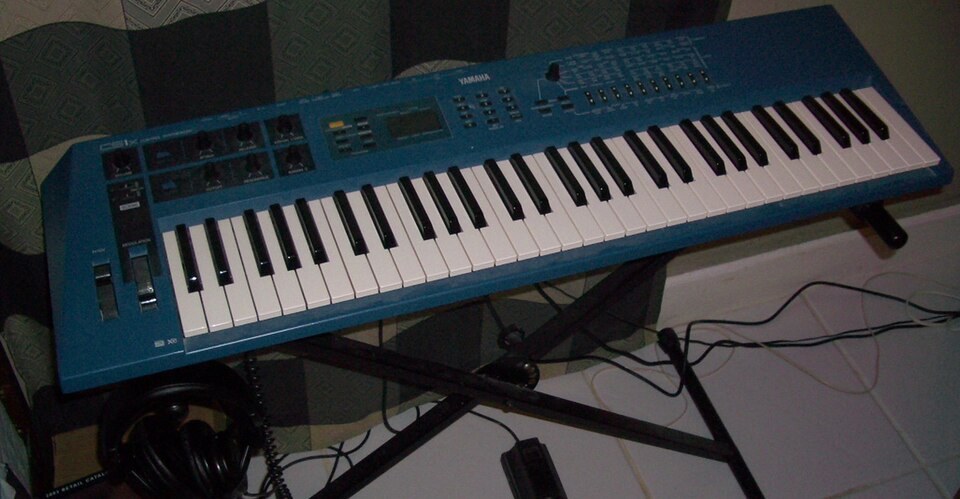
A 61-key synthesizer that Yamaha launched in 1996, aimed mainly at dance musicians. Rather than analogue circuitry it uses sample-plus-synthesis on Yamaha's AWM2 sound source, with 32-note polyphony and Performances of up to four layers, shaped live by six knobs (attack, release, cutoff, resonance and two assignable) and two scene memories that the mod wheel can morph between. It also has a 30-pattern arpeggiator and a 16-part GM/XG sound set with 480 voices and 11 drum kits.
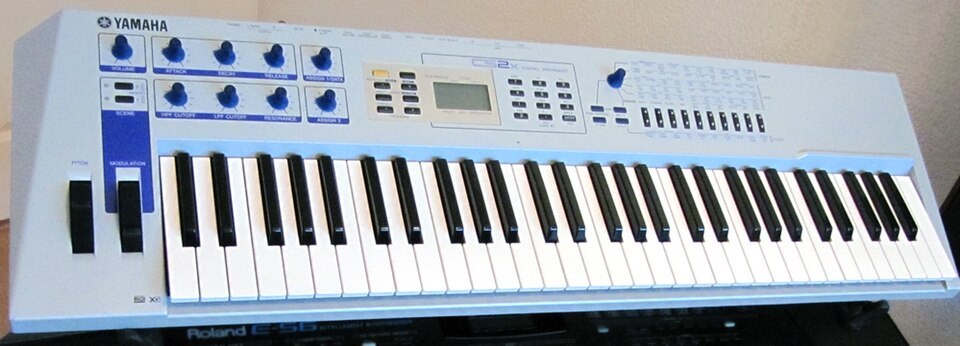
The successor to the CS1x, released by Yamaha in 1999. It keeps the AWM2 sample-and-synthesis approach, the 61-key keyboard and the real-time knobs with two morphable scene memories, but enlarges the wave ROM to 16 MB and doubles polyphony to 64 notes. It also adds a 24 dB/octave high-pass filter alongside the low-pass, EQ for each layer, and a 40-pattern arpeggiator whose patterns can be sent over MIDI, and it keeps an XG mode for multitimbral playback.
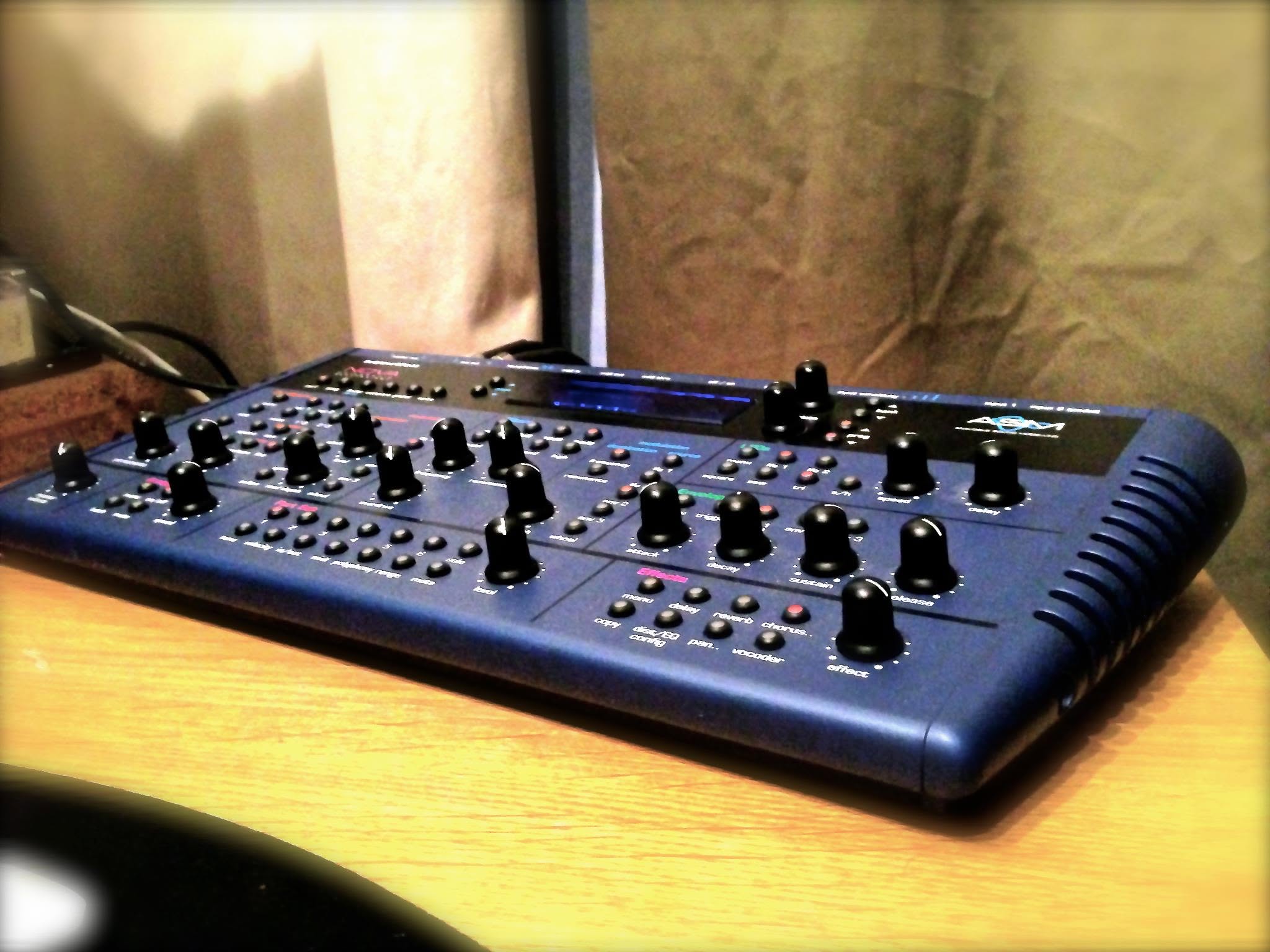
A compact desktop synthesizer, also rack-mountable, that Novation launched in 1999 as a smaller and cheaper version of its Supernova. It uses the same Analogue Sound Modelling (ASM) engine, with three oscillators per voice, low-, band- and high-pass filters of 12, 18 or 24 dB/octave, two LFOs and three envelopes. It has 12 voices and six multitimbral parts, each with its own arpeggiator and up to seven effects such as delay, reverb, chorus, distortion and a comb filter. Unlike the Supernova it has two audio inputs, which can feed the oscillators, the effects or a 40-band vocoder.
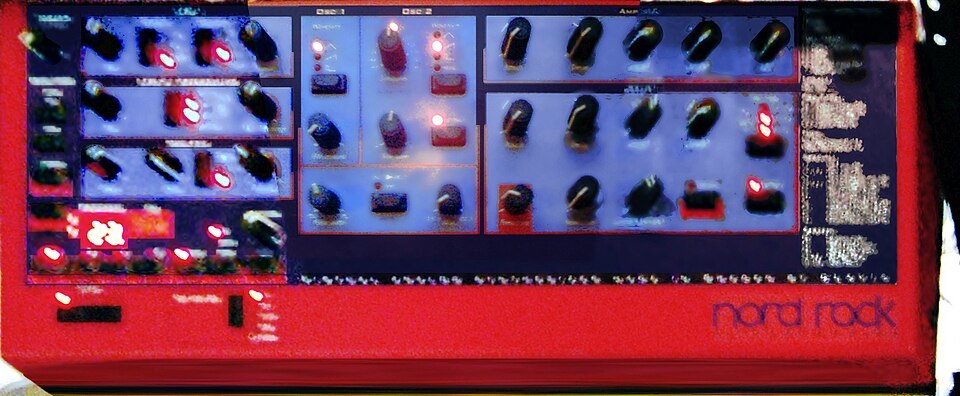
The rack-module version of the Nord Lead, made by Clavia of Stockholm and launched in 1995; it matches the keyboard model apart from the keys, modulation wheel and pitch stick. Its sound is generated in real time by a DSP that models a two-oscillator analogue subtractive synthesizer, without samples, and it is four-part multitimbral. It came with four voices, and an eight-voice expansion board raised polyphony to 12 and added a PCMCIA card slot for extra patch memory. The Nord Lead is credited with popularising the term 'virtual analogue'.
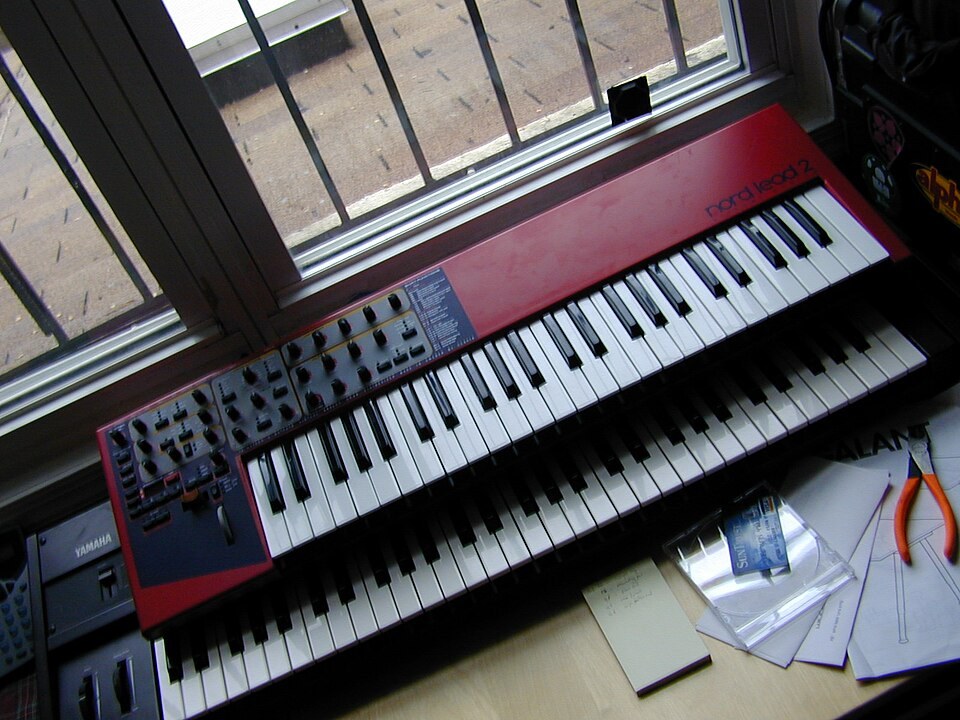
Clavia's second-generation Nord Lead, a virtual-analogue keyboard synthesizer released in 1997 and made until 2003, with a four-octave velocity-sensitive keyboard, Nord's pitch stick and a modulation wheel. It raised polyphony from the original's four voices to 16 and is four-part multitimbral, with a separate output for each part. New features included a sine wave on oscillator 1 for FM sounds, a ring modulator, filter distortion, a notch filter mode, LFOs that sync to MIDI clock and a set of 'analogue' percussion kits.
A Waldorf Pulse. Photo: Qwave and Clusternote, Public domain, via Wikimedia Commons.
Waldorf Pulse
Waldorf · 1996
A monophonic analogue synthesizer in a 2U rack case from the German company Waldorf, introduced in 1996. It has three analogue oscillators (sawtooth, pulse and triangle) plus noise, a resonant 24 dB/octave low-pass filter based on the Minimoog's cascade design, two envelopes, two LFOs, a four-slot modulation matrix and an arpeggiator. Every parameter sends and receives MIDI controller messages. The Pulse Plus of 1997 added an external audio input and a MIDI-to-CV/gate interface.
A clone of Roland's TB-303 Bass Line made by the Dutch company Syntecno, first released in mid-1996. It is a monophonic analogue sound module played over MIDI, with the 303's main controls (tuning, cutoff, resonance, envelope modulation and decay), square and sawtooth waveforms and an 18 dB/octave low-pass filter; accents and slides are triggered by MIDI velocity and controller data. The yellow Mark II, reviewed in 1997, added a ring-modulated waveform and extra MIDI merge inputs, and has an external audio input, DIN sync and four CV/gate outputs for driving older analogue gear.
1999 · The TC Studio · listed as “Syntecno TeeBee 303 (TB-303 clone)”
2001–2002 · The Storage Room · listed as “Syntecno TeeBee MKII”
Korg P3
Korg · 1988
A compact tabletop MIDI tone generator from Korg devoted to piano sounds, listed as released in 1988. It has two built-in piano presets with 16-note polyphony, which can be layered, split or detuned against each other, and a card slot for optional ROM cards that add other sounds. It has MIDI In, Out and Thru, offers only basic sound editing and runs from an external power adapter.
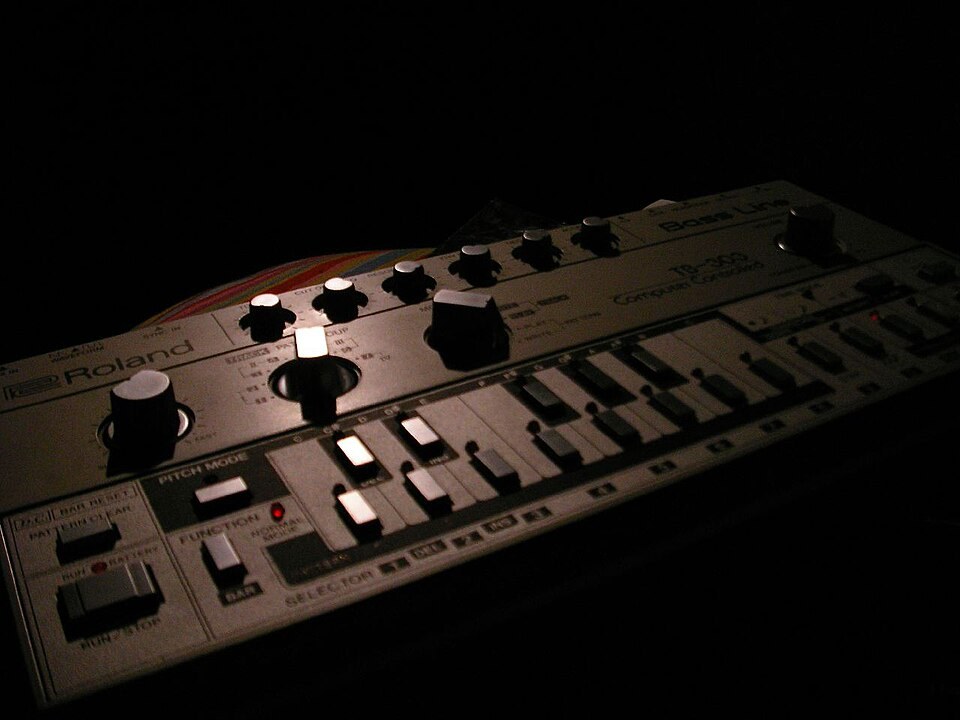
Roland's TB-303 Bass Line is a monophonic analogue bass synthesizer with a built-in step sequencer, launched in 1981. Designed by engineer Tadao Kikumoto to imitate an electric bass as a backing part for solo performers, it produces a sawtooth or square wave through a resonant 24 dB/octave low-pass filter with envelope control, and syncs with the TR-606 drum machine. It sold poorly and was dropped after about 10,000 units were made. Cheap second-hand units later reached electronic musicians, and its squelching filter sound became a foundation of acid house, starting with Phuture's 'Acid Tracks' (1987), as well as of Chicago house and techno.
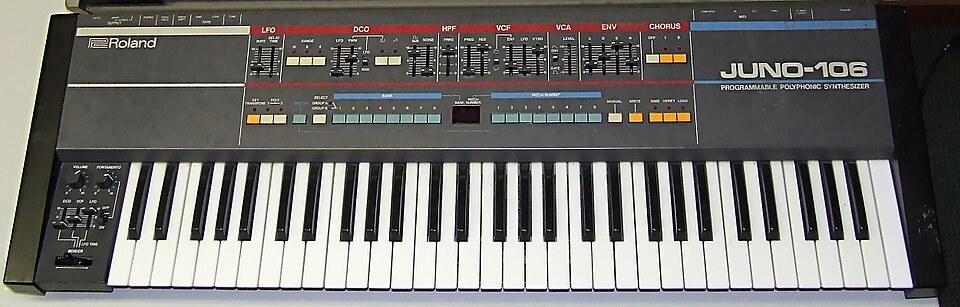
A Roland Juno-106. Photo: Iainf, Public domain, via Wikimedia Commons.
Roland Juno-106
Roland · 1984
A six-voice analogue polyphonic synthesizer released by Roland in February 1984 as the successor to the Juno-60, and made until 1988. Each voice has one digitally controlled oscillator (pulse, sawtooth, square and noise sources), a resonant 24 dB/octave low-pass filter and a non-resonant high-pass filter, followed by the built-in chorus. It added MIDI and 128 patch memories, and was one of the first analogue synths whose parameter changes could be sequenced over MIDI. It remains particularly popular in electronic dance music.
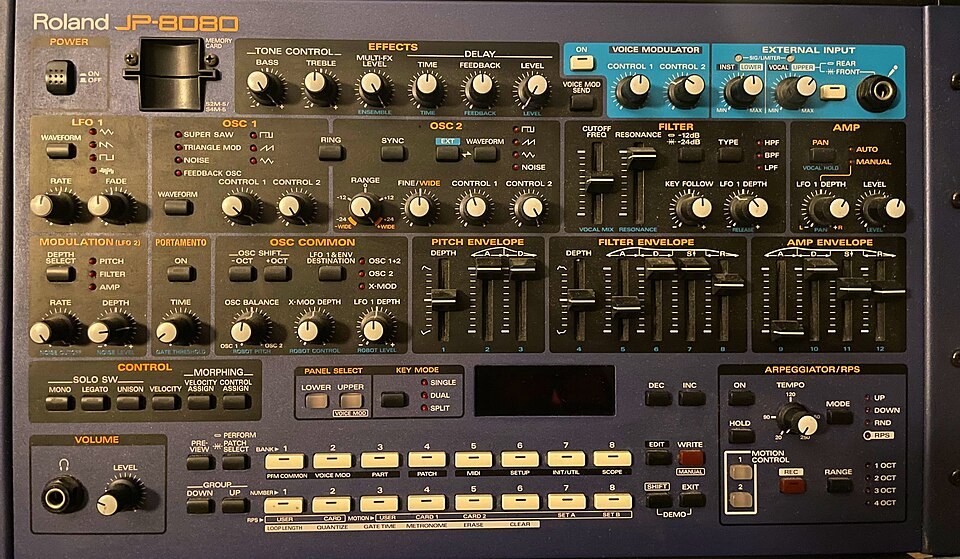
A Roland JP-8080. Photo: Raymangold22, CC0, via Wikimedia Commons.
Roland JP-8080
Roland · 1998
The rack-module version of Roland's JP-8000 analogue-modelling synthesizer, introduced in 1998: a 6U unit with 40 knobs and sliders, the same sound engine and 10-voice polyphony. It adds a voice modulator (vocoder), processing of external audio through the filter and effects, an extra noise waveform, distortion, SmartMedia storage and three times as many patch memories. Its Super Saw waveform, which imitates seven detuned sawtooth oscillators, became central to the lead sounds of anthem (uplifting) trance, and the JP-8080 is heard prominently on Darude's 'Sandstorm'.
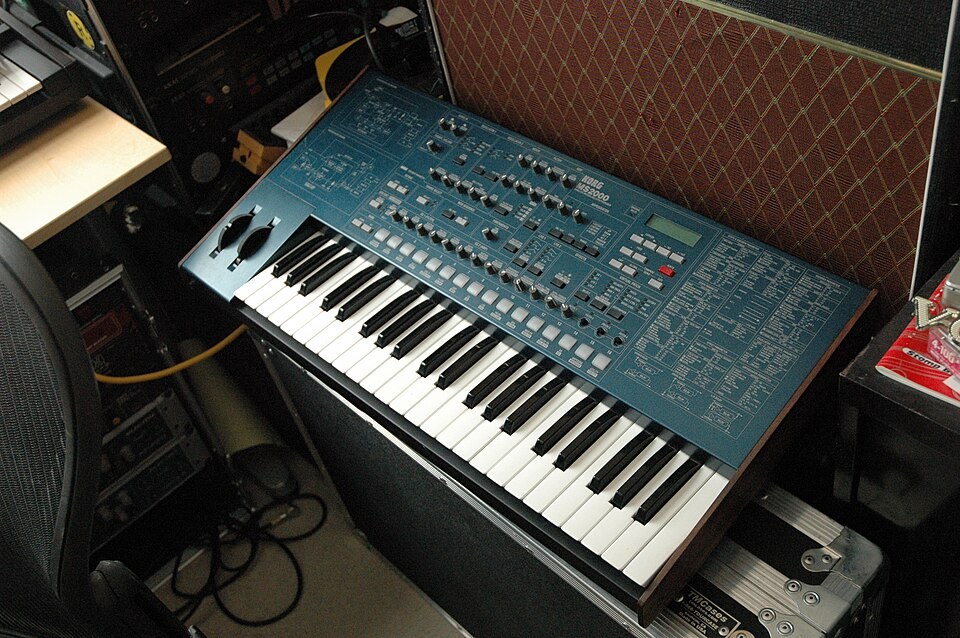
Korg's virtual-analogue synthesizer, released in 2000 and made until 2004, with a 44-note keyboard; the MS2000R is a 4U rack version with the same features. It has four voices, and each program can layer or split two timbres, each with two oscillators (including Korg's DWGS digital waveforms), noise and a multimode resonant filter. It also has a 16-band vocoder, an arpeggiator and a Mod Sequencer of up to three 16-step rows that can record knob movements, and its knobs send MIDI controller data. The MS2000B of 2003 added a microphone for the vocoder.
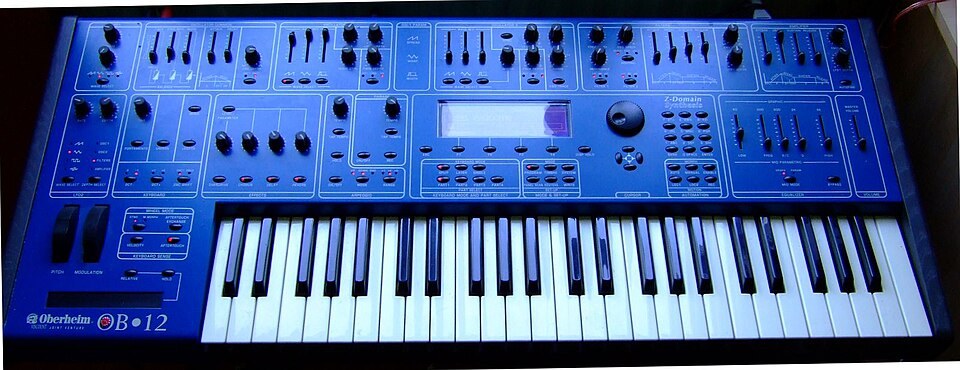
An Oberheim OB-12. Photo: Grapetonix, Public domain, via Wikimedia Commons.
Oberheim OB-12
Oberheim · 2000
A virtual-analogue synthesizer designed and built by the Italian firm Viscount and sold from 2000 to 2005 under the Oberheim name, licensed from Gibson. It has a 49-key keyboard with velocity and aftertouch, 12 voices and four-part multitimbrality, with two oscillators per voice plus noise and ring modulation, and two multimode filters that can run in series, in parallel or split. Almost every parameter has its own knob or slider, alongside a ribbon controller, arpeggiator, phrase recorder, motion recorder and morphing. Early software bugs and its status as an Oberheim in name only limited its acceptance.
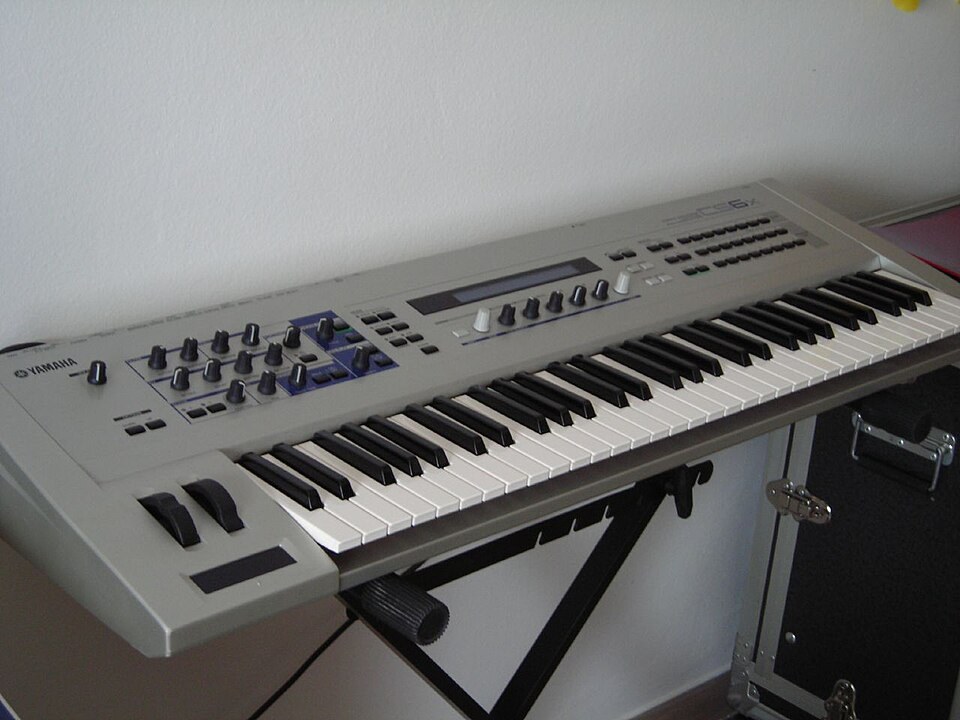
A 61-key synthesizer that Yamaha launched in 1999, with velocity and aftertouch, built on the AWM2 sample-and-synthesis engine: up to four elements per voice drawn from 479 waveforms, 64-note polyphony and 16-part multitimbrality. Alongside real-time control knobs it has a ribbon controller, a 128-pattern arpeggiator and a basic 'Phrase Clip' sampler that stores to SmartMedia cards. Two slots take Yamaha's PLG plug-in boards, several of which add whole synthesis methods such as analogue modelling (PLG150-AN) or six-operator FM (PLG100-DX); the CS6R is the rack version.
A plug-in expansion board for Yamaha's Modular Synthesis Plug-in System that adds an analogue physical-modelling synth engine closely based on the AN1x. Each voice has two oscillators, a resonant multimode filter (4-, 3- or 2-pole low-pass, band-pass, band-eliminate and high-pass), an amplifier and two LFOs, plus distortion and a three-band EQ. The board plays five notes at once on a single MIDI channel and holds 256 preset and 128 user voices. It works in hosts including the CS6x and CS6R, the S80, the MU100R and MU128 modules and the SW1000XG card.
2001–2002 · The Storage Room · listed as “Yamaha AN1x (CS6x plug-in board)”
Drum machines and grooveboxes
A Novation Drum Station. Photo: ZoeB, CC BY-SA 4.0, via Wikimedia Commons.
Novation Drum Station
Novation · 1997
The Drum Station is a 1U rack module from Novation that recreates the sounds of Roland's TR-808 and TR-909 drum machines. It has no sequencer of its own and is played over MIDI: most drums are produced by Novation's Analogue Sound Modelling, while a few, such as cowbell, claves, maracas and hand clap, are samples. It has a stereo output plus six individual outputs, front-panel knobs whose movements are sent as MIDI controller data, and a Sync 24 output for driving older Roland gear such as the TB-303. The orange V2 of 1997 repackaged the original 1996 design with updated software that fixed a polyphony bug affecting the samples.
1999 · The TC Studio · listed as “Novation Drumstation V2”
2001–2002 · The Storage Room · listed as “Novation Drumstation V2”
Jomox AirBase 99
Jomox · 1998–2005
The AiRBase 99 is a 1U rack drum module from the Berlin company JoMoX, built on the sound engine of its earlier XBase 09 drum machine but without that machine's knobs and pattern sequencer, so it is controlled mainly over MIDI. Bass drum, snare and the two toms are generated by analogue circuits under digital control, while hi-hats, clap, rimshot, crash and ride come from ROM samples, including TR-808 and TR-909 variants, shaped by analogue envelopes. It has nine voices, ten individual outputs plus a stereo mix, a resonant filter for the hi-hats and two LFOs that can follow MIDI clock. JoMoX made it from 1998 to 2005.
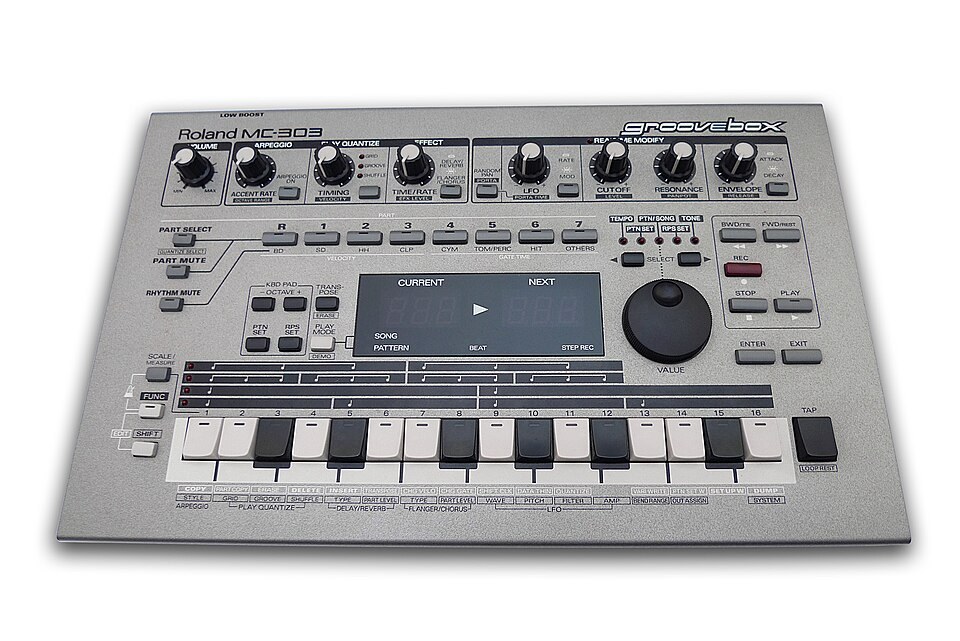
A Roland MC-303. Photo: Nina Richards, Public domain, via Wikimedia Commons.
Roland MC-303 Groovebox
Roland · 1996
The MC-303 was Roland's first Groovebox, released in 1996: a sample-based sound module combined with a pattern sequencer and real-time controls for building and improvising tracks, aimed at DJs and home musicians. Its 448 preset sounds and 12 drum kits draw largely on classic Roland instruments such as the TB-303, TR-808, TR-909 and Juno synthesizers, and can be shaped with a resonant filter, envelope and LFO, with built-in reverb, delay and chorus. It has 28-voice polyphony and an eight-track sequencer, but cannot sample. Reviewers criticised its preset-only sound engine, and it was followed by a long line of Grooveboxes beginning with the MC-505.
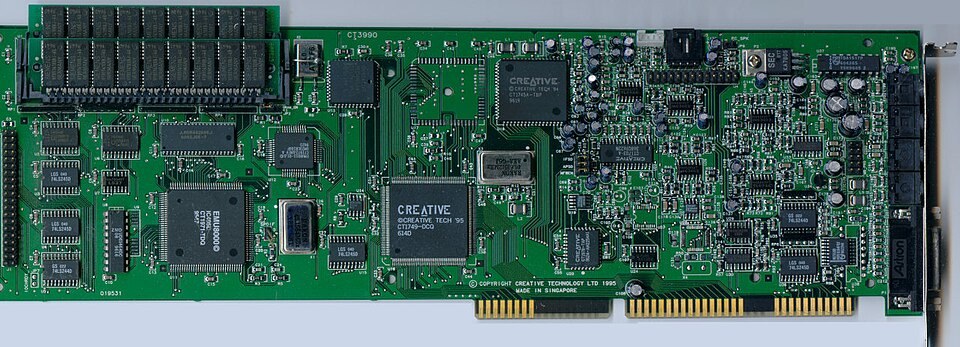
A Sound Blaster AWE32. Photo: Swaaye, Public domain, via Wikimedia Commons.
Sound Blaster AWE32
Creative · 1994
The Sound Blaster AWE32 (Advanced WavEffects) is a full-length ISA sound card from Creative, introduced in March 1994. Next to Creative's usual digital audio section and a Yamaha OPL3 FM chip, it carries a sample-based synthesizer built on E-mu's EMU8000 chip, with 1 MB of sample ROM and 512 KB of sample RAM that could be expanded with SIMM memory to 28 MB. It was the first sampler to support E-mu's SoundFont format, so users could build and load their own sound sets from their own samples.
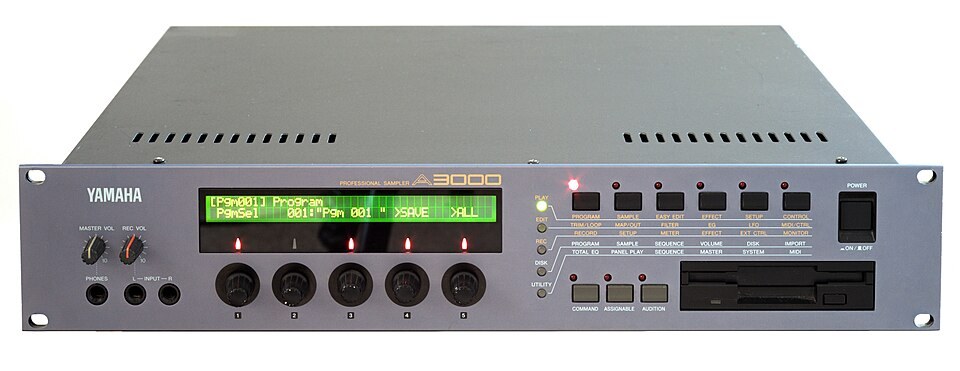
The A3000 is a 16-bit stereo rack sampler that Yamaha released in 1997 as the successor to its TX16W of 1988. It has 64-note polyphony, 16-part multitimbrality, digital filters and 2 MB of sample memory expandable to 128 MB with SIMMs, plus a three-channel multi-effects unit that can also be used on its own as an effects processor. An optional expansion board added S/PDIF input and three pairs of extra outputs, and a 1998 software upgrade, sold as the A3000 v2, improved the interface and added Roland sample import. It was succeeded by the A4000 and A5000 in 2000.
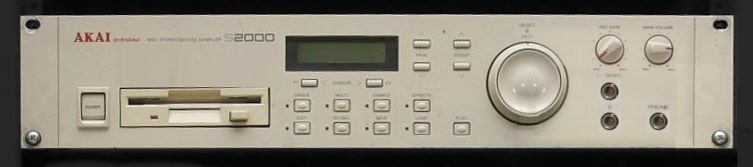
The S2000 is a 16-bit stereo sampler from Akai, launched in 1995 as an affordable, expandable member of its S-series in a 2U rack case. It has 32-voice polyphony, 16-part multitimbrality, resonant low-pass filters, a two-line display, a floppy drive and SCSI as standard, and 2 MB of sample memory expandable to 32 MB. Optional boards added multi-effects, S/PDIF with eight assignable outputs, and further filter types, and it reads Akai S-series sample CD-ROMs. Sound On Sound's 1995 review praised it as very good value at £999.
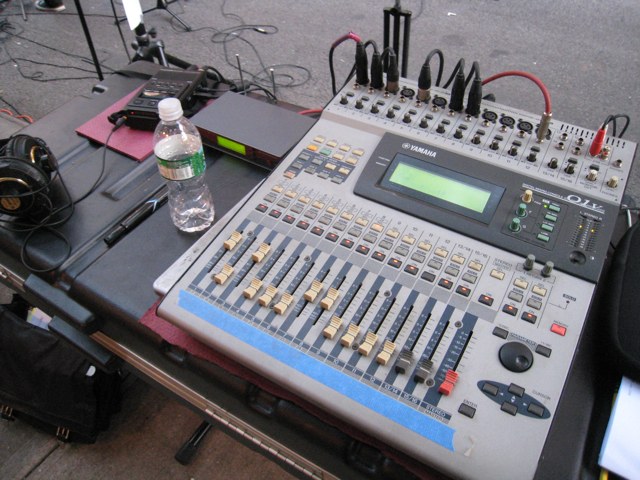
A Yamaha 01V in use at a festival. Photo: joce01_y, CC BY 2.0, via Wikimedia Commons.
Yamaha 01V
Yamaha · 1998
The 01V is a compact digital mixer, Yamaha's entry-level model when Sound On Sound reviewed it in 1998. It has 16 analogue inputs (12 mono mic/line channels and two stereo pairs) plus a stereo S/PDIF input, motorised faders, four-band parametric EQ and a dynamics processor on every channel, and two internal effects processors derived from Yamaha's ProR3 and REV500 units. It uses 20-bit converters with 32-bit internal processing, and an option slot takes cards with eight channels of ADAT, TDIF or AES/EBU digital input and output, or eight extra analogue inputs.
1999 · The TC Studio · listed as “Yamaha 01V with analogue input expansion (24 channels)”
2001–2002 · The Storage Room · listed as “Yamaha 01v, 24 channels (8 analogue inputs expansion)”
2001–2002 · The Storage Room · listed as “Yamaha 01v, 16 channels”
Yamaha DSP Factory
Yamaha · 1998
The DSP Factory is a PC recording and mixing system built around Yamaha's DS2416 PCI card, which carries the mixing functions of Yamaha's 02R digital console on its own DSP chips, so that mixing and effects do not load the computer's processor. The card plays back 16 tracks from hard disk and mixes up to 24 channels, each with four-band parametric EQ and dynamics, and it has two stereo effects processors based on Yamaha's REV500 reverb. On its own it has stereo analogue and S/PDIF connections; AX44 expansion units added analogue inputs and outputs for recording up to eight tracks at once, and two cards could be linked. It depended on third-party recording software such as Cubase VST/24 for its controls.
2001–2002 · The Storage Room · listed as “Yamaha DSP Factory (digital mixing and recording card)”
Creamware Pulsar II
Creamware · 2000
The Pulsar II is a PCI DSP card from the German company Creamware, announced at the Frankfurt Musikmesse in 2000 as the successor to the original Pulsar, for Windows and Mac. It carries six Analog Devices SHARC processors, about 50 percent more computing power than its predecessor, which run Creamware's modular environment of synthesizers, sample players, effects and mixers instead of the computer's own processor. As standard it has 20 inputs and outputs (stereo analogue, stereo S/PDIF and two ADAT optical ports) at up to 24-bit/96 kHz, and it can be linked with other cards in Creamware's SCOPE family over their own bus.
The A16 Ultra is a 1U rack converter from Creamware with 16 channels of analogue-to-digital and 16 of digital-to-analogue conversion at up to 24-bit/96 kHz, on balanced jack connections, announced in 2001. Its digital connections are two ADAT optical interfaces, which carry eight channels at 96 kHz using S/MUX, two of Creamware's Z-Link interfaces, which carry all 16 channels at 96 kHz to a Creamware DSP card fitted with Z-Link, and word clock. Sixteen level meters on the front panel help set levels. Ferrofish later made an A16 Ultra MkII.
Recalled by Alexander · listed as “2 × Creamware A16 Ultra”
They replaced both Yamaha 01V mixers.
Soundcraft Ghost.
Soundcraft Ghost
Soundcraft · 1996
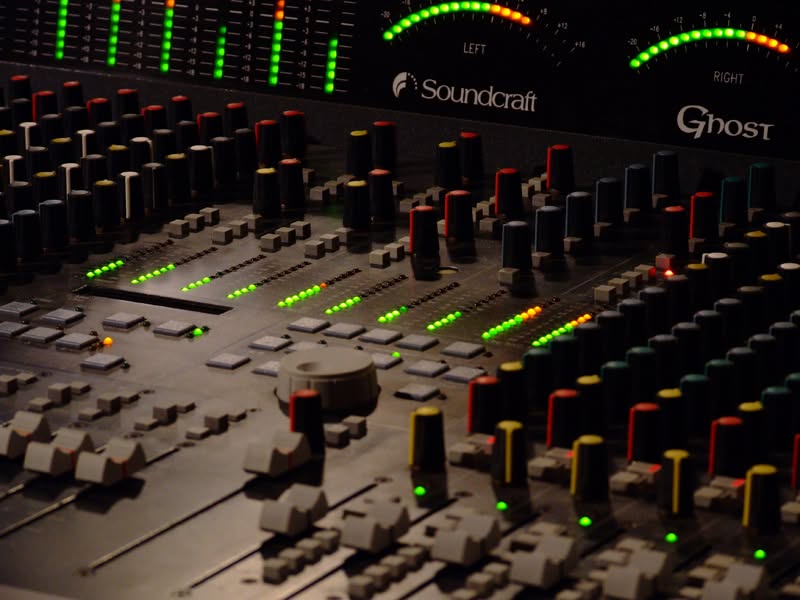
The Ghost is an analogue in-line recording console from the British company Soundcraft, launched in 1996 for project studios in 24- and 32-channel frames. It has eight group buses, four-band EQ with two fully parametric mid bands, ten aux sends and four stereo effects returns. The standard Ghost adds mute automation, as snapshots against timecode or per-channel mutes driven from a MIDI sequencer, and MIDI Machine Control of tape and disk recorders; the cheaper Ghost Le leaves these out. Sound On Sound's 1996 review praised its sound quality and value for money.
2013–2015 · With the Soundcraft Ghost · listed as “Soundcraft Ghost 32 console”
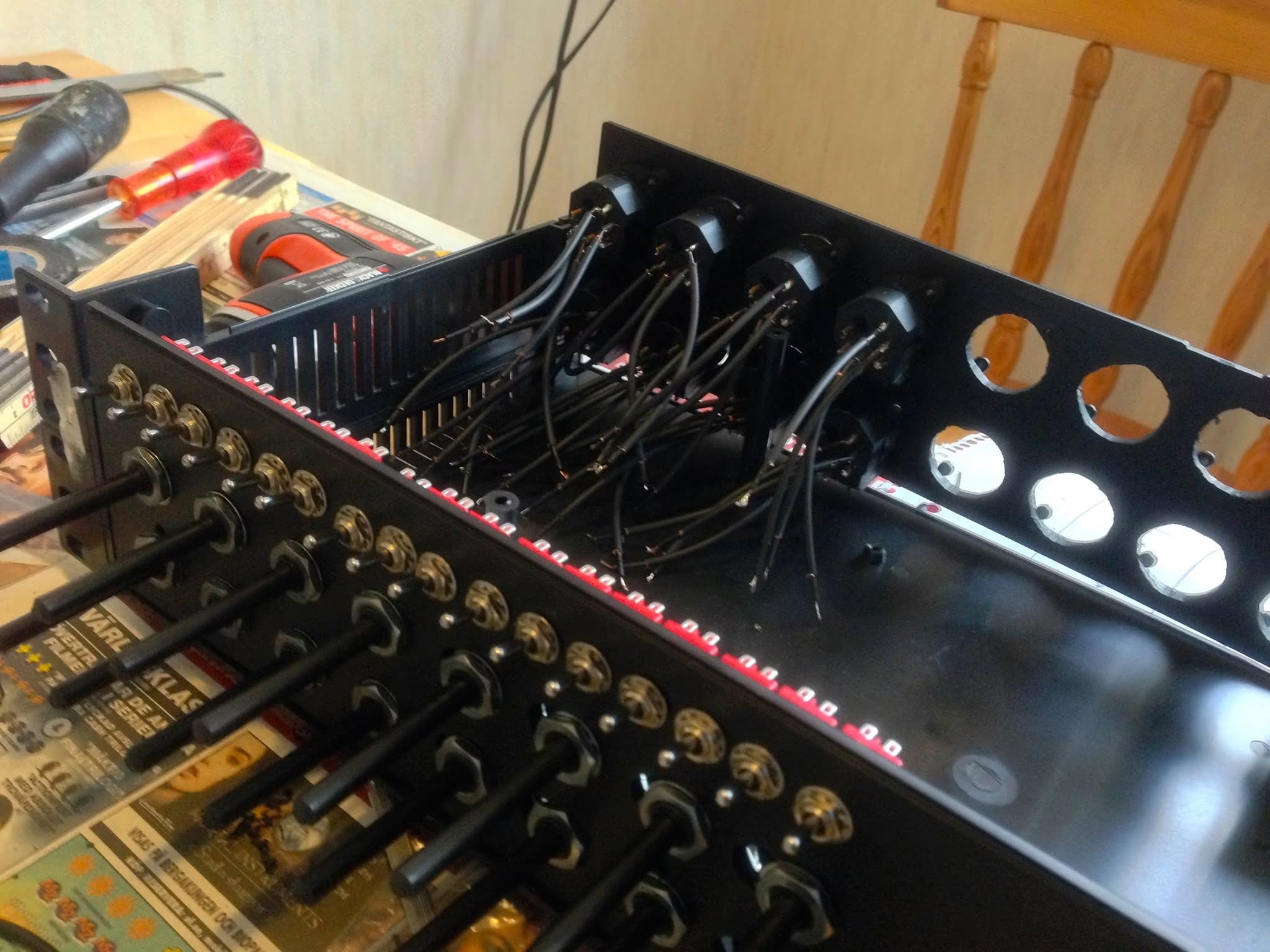
Being built: the back panel being wired.
The studio's own summing mixer
trance[]control
A passive, balanced 16-channel analogue summing mixer of Alexander's own design, still being built: M/S processing through Lundahl transformers, a B channel pair for the dry stereo mix, and switches that set each channel to mono, left or right.
Today · listed as “Passive balanced 16-channel summing system”
Designed by Alexander: M/S processing through Lundahl transformers. Still not finished.
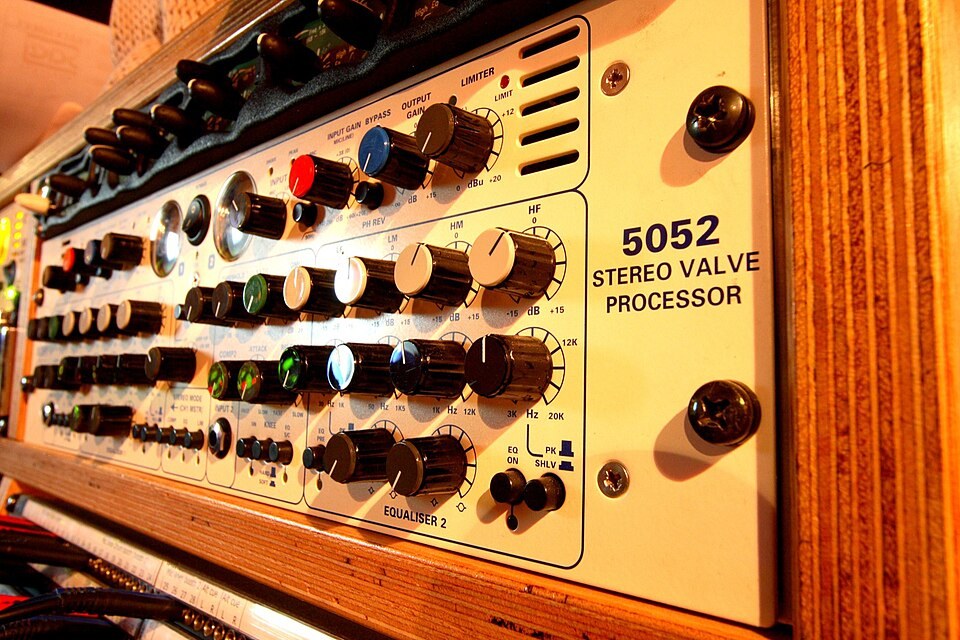
The Ivory 2 5052 is a two-channel valve recording processor from the British company TL Audio, part of its Ivory 2 series. Each channel combines a mic, line and instrument preamp, a compressor, a four-band EQ with two parametric mid bands and an output limiter, in a hybrid design that pairs solid-state circuitry with three ECC83 (12AX7) dual-triode valves. The channels can work separately or be linked for stereo, and an optional DO-2 card adds 24-bit digital output at 44.1 or 48 kHz. It is a 3U rack unit, which Sound On Sound reviewed in 2003 as a capable, easy-to-use processor for tracking, mixing and mastering.
The Studio 1204 is an inexpensive digital multi-effects processor from Zoom, released in late 1996 as a true-stereo successor to the Studio 1202. It offers 512 preset effects in two banks, one of reverbs and delays (including hall, room, plate, gated and reverse) and one of modulation and special effects such as chorus, flanger, pitch shift, rotary speaker and vocoder, plus 100 user memories. It uses 18-bit converters at 44.1 kHz and responds to MIDI program changes and controllers. Sound On Sound found it good value and easy to use, though not the first choice for high-quality reverb.
Recalled by Alexander · listed as “Zoom 1204 reverb”
Interfaces and controllers
Opcode Studio 128X
Opcode
The Studio 128X is an eight-port MIDI interface and patchbay from Opcode Systems of Palo Alto, California; with 16 MIDI channels per port it handles 128 channels in all. It connects to a Mac or Windows PC through a serial port and can route, merge and filter MIDI between any of its inputs and outputs, storing routing programs that also work without a computer. It can also write and follow SMPTE timecode for basic synchronisation with tape. Sound On Sound reviewed it in 1998 as the larger sibling of the four-port Studio 64X, the same year Gibson bought Opcode; the company's product development stopped in 1999.
1999 · The TC Studio · listed as “Opcode Studio 128x MIDI interface”
2001–2002 · The Storage Room · listed as “Opcode Studio 128x MIDI interface”
TC Electronic Desktop Konnekt 6
TC Electronic · 2008
The Desktop Konnekt 6 is a compact desktop FireWire audio interface and monitor controller from TC Electronic, introduced in 2008. It has one mic preamp with phantom power, two instrument inputs, line inputs, balanced stereo outputs and a headphone output, recording at up to 24-bit/192 kHz with TC's JetPLL jitter reduction. A large illuminated volume knob, Dim and Mono buttons and level meters let it serve as a monitor controller, and it can be powered over FireWire. It came with Cubase LE 4 and a TC reverb plug-in.
2012 · The new studio · listed as “T.C. Electronic Konnekt 6 (FireWire sound card)”
The UF60's faders and knobs.
CME UF60
CME · 2007
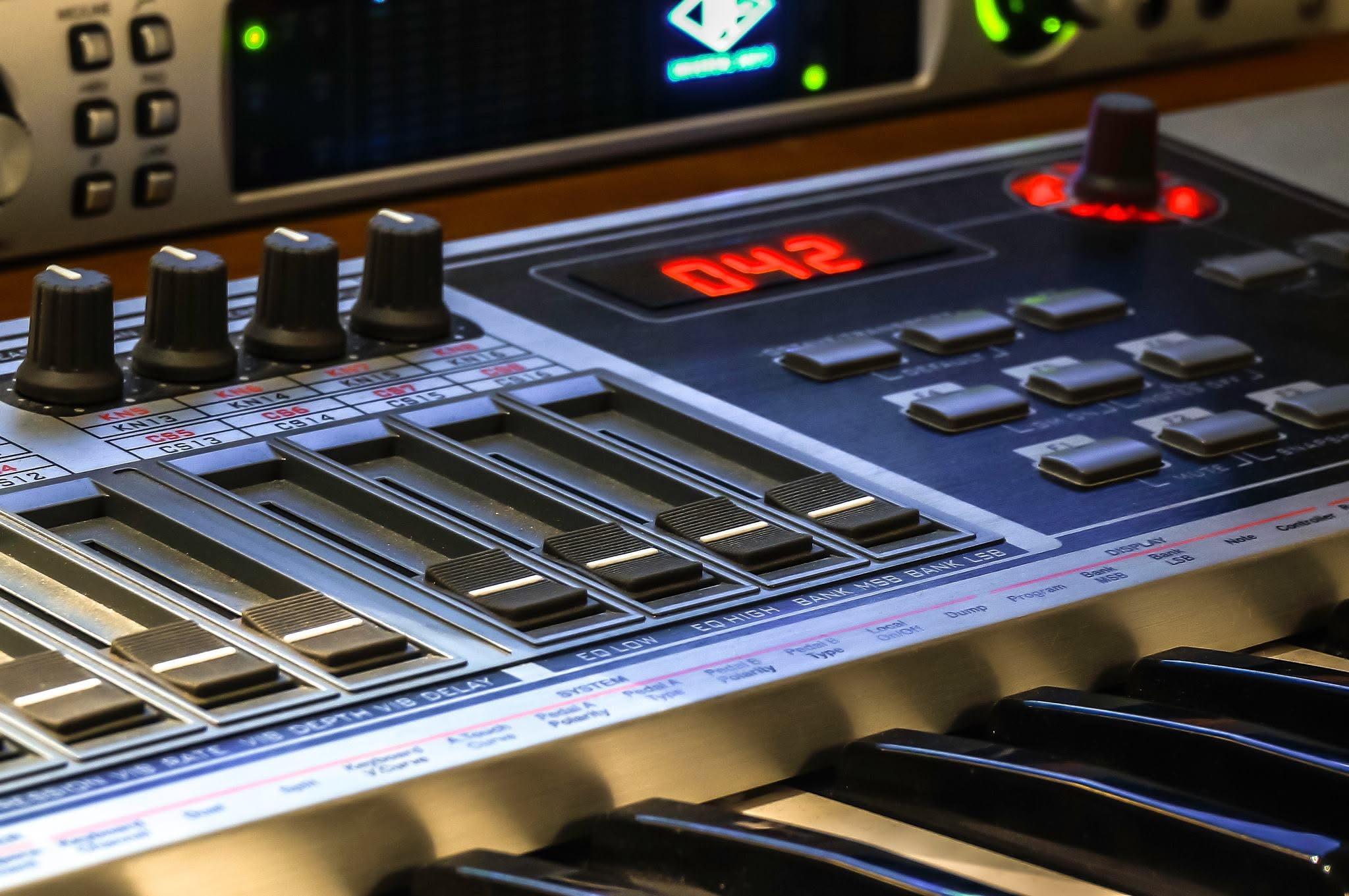
The UF60 is the 61-key model in CME's UF series of master keyboards, announced in January 2007 alongside the 49-key UF50, 76-key UF70 and 88-key UF80. It has a semi-weighted keyboard with aftertouch, nine assignable faders, eight assignable knobs, six transport buttons and an aluminium case. CME presented the series as the first master keyboards with a built-in two-way wireless MIDI link: a supplied USB receiver gives a range of up to 80 metres, and the keyboard can also connect directly over USB, which can power it. It also has a MIDI output, breath-controller and pedal inputs, and a slot for optional expansion boards.
2012 · The new studio · listed as “CME UF60 MIDI keyboard (USB / WiFi)”
2015–2017 · Studio 7 · listed as “CME UF60 MIDI keyboard (USB / WiFi)”
An Apollo Quad: the same interface, with four processors instead of the Duo's two. Photo: Alex Regan, CC BY 2.0, via Wikimedia Commons.
Universal Audio Apollo Duo
Universal Audio · 2012
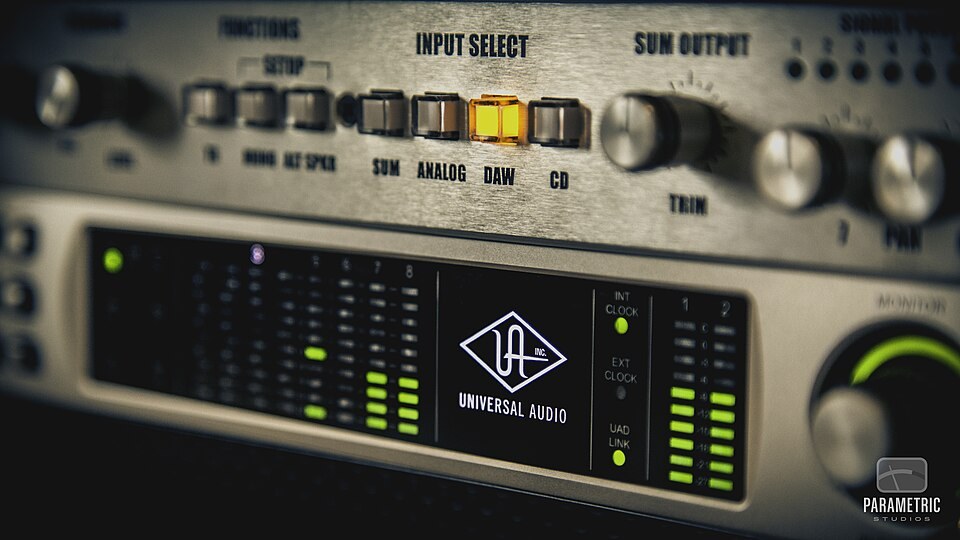
The Apollo is a 1U rack audio interface from Universal Audio, announced in January 2012, whose built-in UAD-2 DSP runs the company's plug-in emulations of analogue equipment while recording and monitoring, with latency of around 2 milliseconds. The Duo version has two Analog Devices SHARC processors, the Quad four. It has 18 inputs and 24 outputs, including four digitally controlled mic preamps, two front-panel instrument inputs, eight analogue line inputs and outputs, ADAT and S/PDIF, with 24-bit/192 kHz conversion and UA's Console software for routing and monitoring. This first-generation model connects over FireWire 800 as standard, with Thunderbolt available through an optional card.
2015–2017 · Studio 7 · listed as “Universal Audio Apollo Duo (Thunderbolt)”
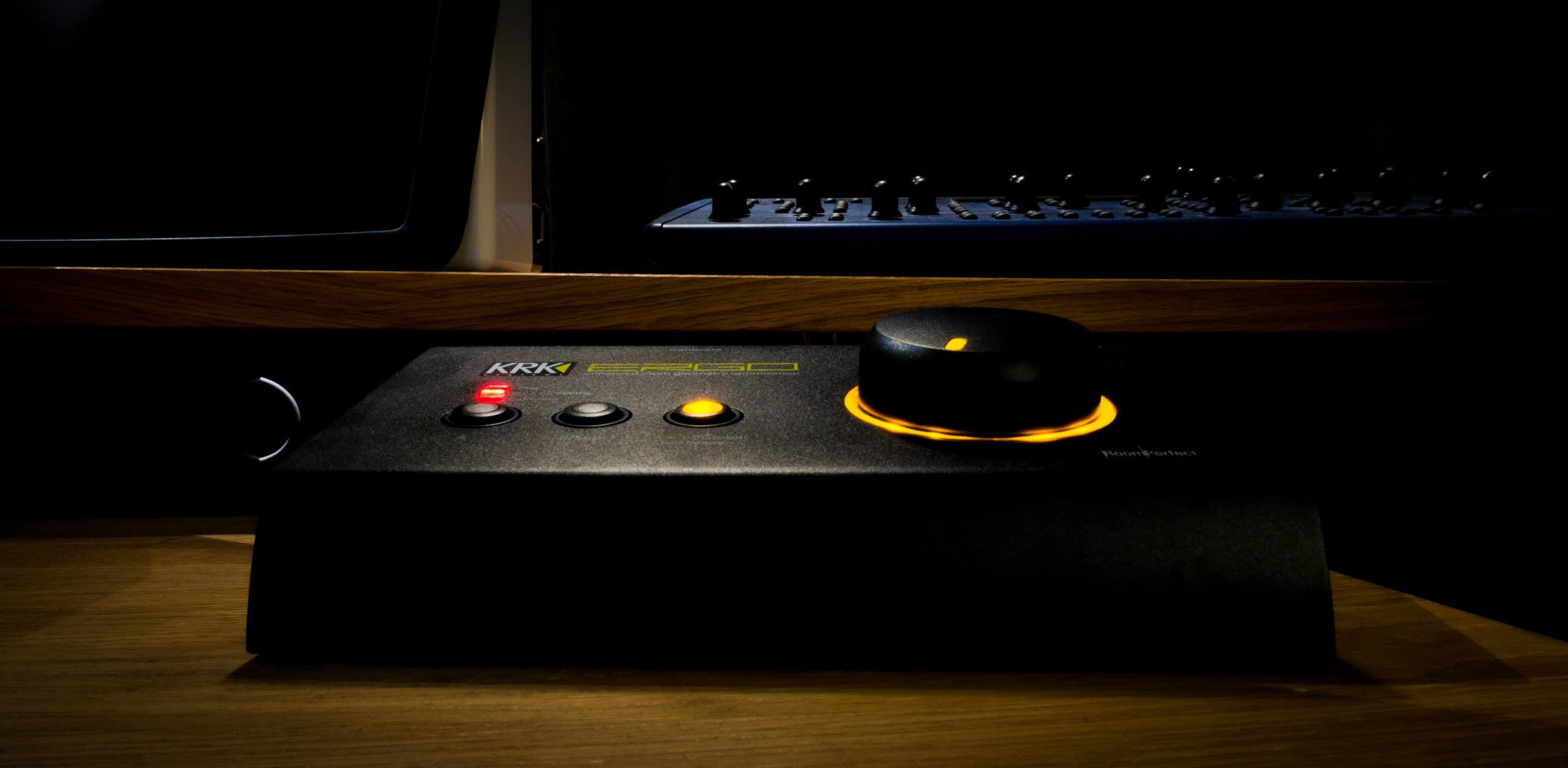
KRK Ergo room correction.
KRK Ergo
KRK · 2008
Ergo (Enhanced Room Geometry Optimization) is a room-correction system from KRK, launched in 2008. A supplied measurement microphone and calibration software measure the monitors at several positions in the room, and a desktop DSP unit then applies correction filters, using the RoomPerfect method licensed from Lyngdorf Audio, to reduce room resonances between 20 and 500 Hz. Focus mode concentrates the correction on the main listening position and Global mode spreads it over a wider area. The unit sits between the computer and the monitors, also works as a FireWire audio interface and monitor controller with switching between two pairs of speakers or a subwoofer, and runs on its own once calibrated.
2015–2017 · Studio 7 · listed as “KRK Ergo room correction”
M-Audio Axiom 61
M-Audio · 2006
The Axiom 61 is a 61-key USB MIDI controller keyboard from M-Audio. The Axiom line was announced in January 2006 in 25-, 49- and 61-key sizes; the 61 has semi-weighted keys with assignable aftertouch, eight rubber trigger pads taken from M-Audio's Trigger Finger, eight endless rotary encoders, nine sliders and transport buttons, can be powered over USB and also has MIDI In and Out sockets. A second generation kept this layout and added DirectLink, which maps the controls automatically to common recording programs such as Pro Tools, Logic, Cubase and Live.
1999 · The TC Studio · listed as “Avance Epsilon 910 monitors”
Audio Pro subwoofer
Audio Pro
The Audio Pro B1.39 is an active subwoofer from the Swedish company Audio Pro, with a 10-inch bass driver and a built-in amplifier in a cabinet about 29 × 52 × 42 cm. Like Audio Pro's other subwoofers it is based on ACE-Bass, a technique patented in 1978 by the company's engineer Karl-Erik Ståhl, in which the amplifier electrically changes how the bass driver behaves so that a small cabinet can produce deeper bass.
A stereo power amplifier from NAD's THX-certified home-theatre range, rated at 125 W per channel into 8 ohms and 200 W into 4 ohms, and bridgeable to a single 400 W channel. It has dual-mono construction with mirror-image amplifier boards, a Holmgren toroidal transformer, a separate regulated supply for the input stage and switchable Soft Clipping, and NAD designed it to drive difficult speaker loads. It passed Lucasfilm's THX requirements, and NAD says it was the first company to introduce a THX-certified power amplifier.
A two-way stand-mount (bookshelf) loudspeaker from Bowers & Wilkins's DM600 range, which was updated to S2 (Series 2) form in 1999. It pairs a 180 mm woven Kevlar bass/midrange cone with a metal-dome tweeter, which in the S2 version gained the tapered-tube loading developed for B&W's flagship Nautilus 800 series to reduce treble colouration. The vented cabinet has a front-facing port, and B&W quotes a response of 52 Hz–20 kHz (±3 dB), 90 dB sensitivity and 8 ohms nominal impedance.
2001–2002 · The Storage Room · listed as “B&W DM602-S2 monitors”
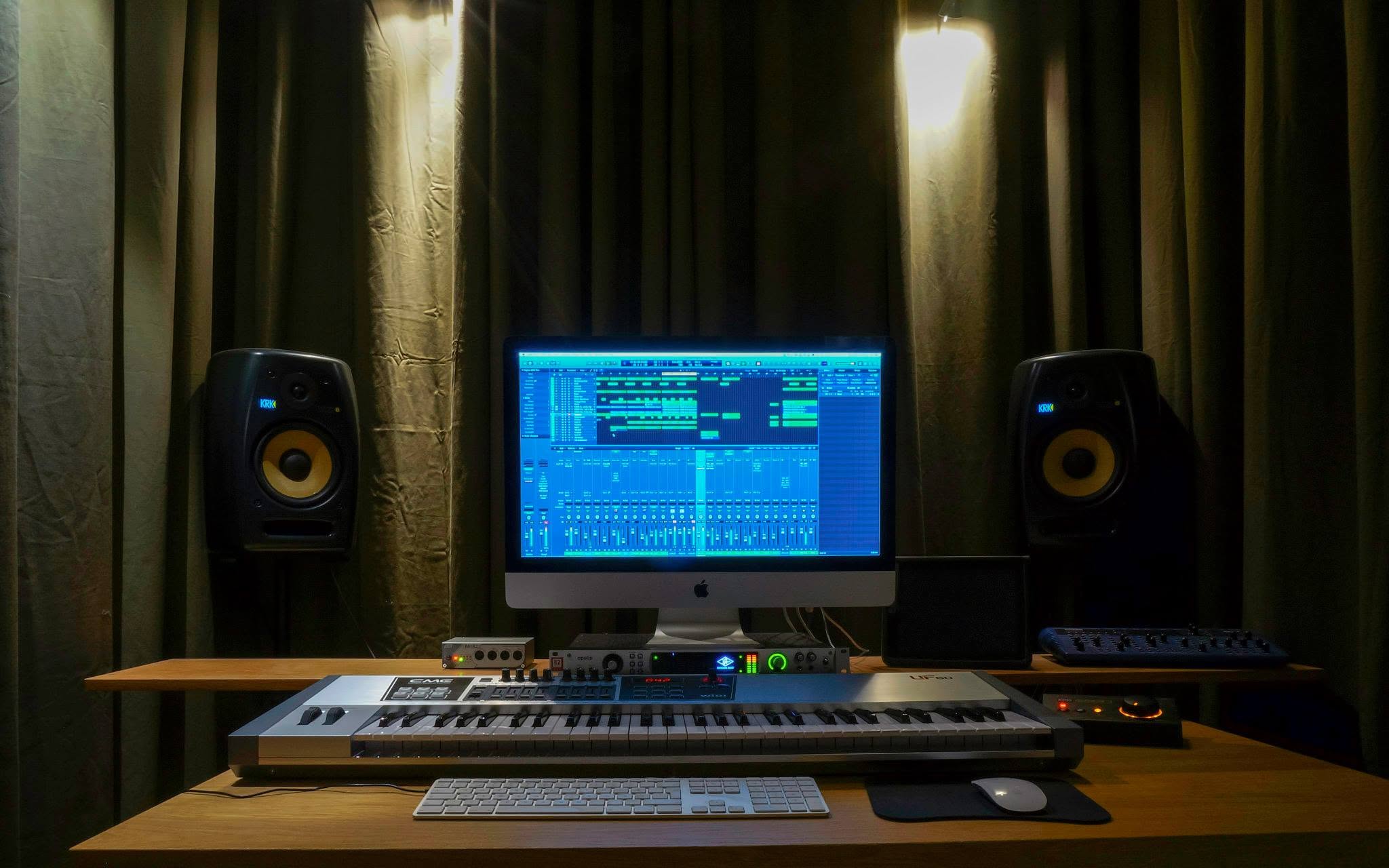
The KRKs either side of the iMac.
KRK VXT8
KRK · 2008
An active two-way studio monitor from KRK's VXT series, introduced in 2008. An 8-inch woven Kevlar woofer and a 1-inch silk-dome tweeter are driven by separate 120 W and 60 W amplifiers, in a rounded cabinet of damped ABS structural foam with slotted ports to reduce port noise. KRK quotes a response of 37 Hz–22 kHz (±1.5 dB), and rear-panel switches adapt the bass to the speaker's position and adjust the treble by ±1 dB.
2012 · The new studio · listed as “KRK VSTX8 studio monitors”
2015–2017 · Studio 7 · listed as “KRK VSTX8 main studio monitors”
Tannoy Reveal 402
Tannoy · 2014
A compact active two-way monitor from Tannoy's Reveal range, announced at NAMM in January 2014. A 4-inch woofer and a ¾-inch tweeter are each driven by 25 W, with a front bass port and a quoted response of 56 Hz–48 kHz; the crossover was tuned by Tannoy's speaker designer Dr Paul Mills for a wide sweet spot. An Aux Link input lets a music player feed a linked pair, and Sound On Sound judged it best suited to very small rooms or desktop use.
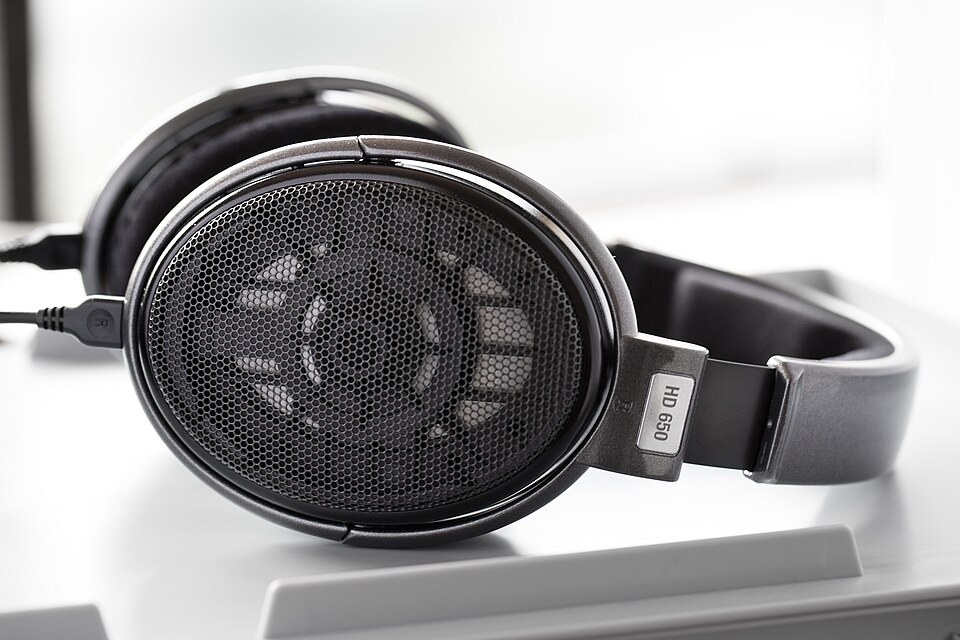
Open-back, around-ear dynamic headphones that Sennheiser introduced in 2003, developed from its HD 600 with improved materials. They use 42 mm drivers with a nominal impedance of 300 ohms, so they are usually driven from a dedicated headphone amplifier, and have a detachable 3 m cable. The specified frequency response is 10 Hz–41 kHz.
2012 · The new studio · listed as “Sennheiser HD650 reference headphones”
2015–2017 · Studio 7 · listed as “Sennheiser HD650 reference headphones”
Microphones
RØDE NT1
RØDE · 1991
A cardioid large-diaphragm condenser microphone from RØDE. The original NT1 came out in 1991, and the model has been revised several times since. The later NT1, now listed by RØDE among its legacy products, has an internally shock-mounted 1-inch gold-sputtered capsule and a self-noise of 4.5 dB(A), which RØDE describes as one of the quietest of any studio microphone; a fifth-generation version with a USB output followed in 2023, and the analogue-only NT1 Signature in 2024.
1999 · The TC Studio · listed as “RØDE NT1 studio microphone”
2001–2002 · The Storage Room · listed as “RØDE NT1 microphone”
Shure BG 1.0
Shure
A cardioid dynamic microphone from Shure's BG series, an affordable range for live sound and basic recording. By the late 1990s the series had been updated with models numbered from BG 1.1 upwards, in which the BG 1.1 was the basic dynamic model.
A direct-drive DJ turntable from the Japanese company Vestax, part of the PDX range of professional DJ turntables that Vestax launched in the late 1990s to compete with Technics' SL-1200. It plays at 33 and 45 rpm with a ±10% pitch control, and users have praised its torque and its stability when scratching. Vestax, founded in Tokyo in 1977, went bankrupt in 2014.
2001–2002 · The Storage Room · listed as “2 × Vestax PDX-a1 MKII turntables”
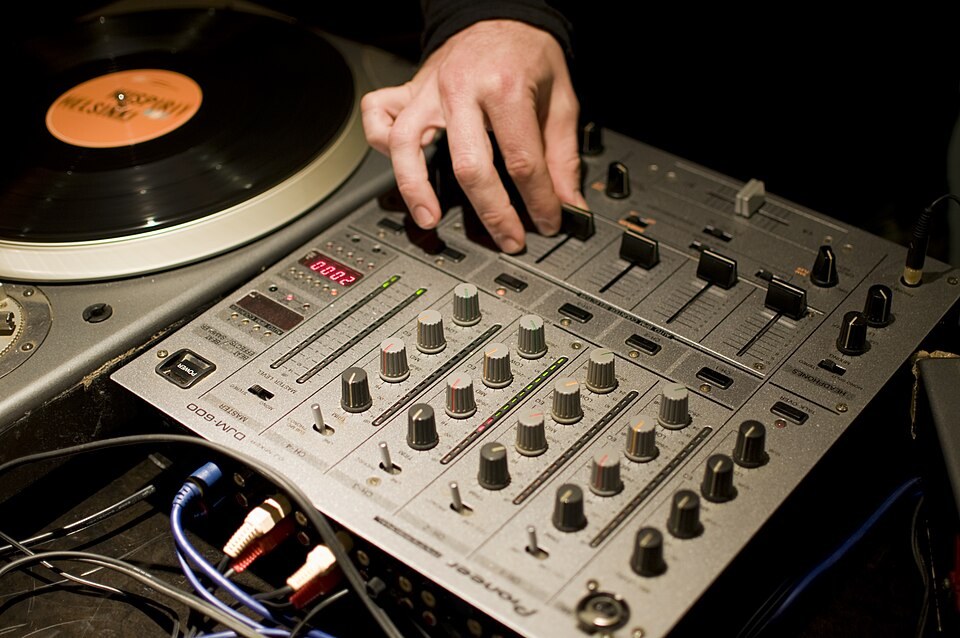
A Pioneer DJM-600. Photo: galki, CC BY 2.0, via Wikimedia Commons.
Pioneer DJM-600
Pioneer · 1998
A four-channel DJ mixer from Pioneer that followed the DJM-500 and became a club standard. Its Beat Effects (delay, echo, reverb, flanger, filter, pan, pitch and transition) are synchronised to the music by an automatic BPM counter, and a built-in sampler records up to eight seconds of sound and can stretch the loop to the beat. Each channel has a three-band EQ, and the model stayed in production for more than ten years.
2001–2002 · The Storage Room · listed as “Pioneer DJM600 mixer”
Hercules DJ RMX
Hercules · 2008
A USB DJ controller with a built-in audio interface, announced by Hercules in April 2008 as the DJ Console Rmx. It has a metal casing with two jog wheels, six faders, 12 rotary controls and 46 buttons, and its sound card has two stereo inputs (switchable between line and phono level) and two stereo outputs, plus microphone and headphone connections. It was bundled with VirtualDJ DJC Edition and can also act as a controller for other DJ software.
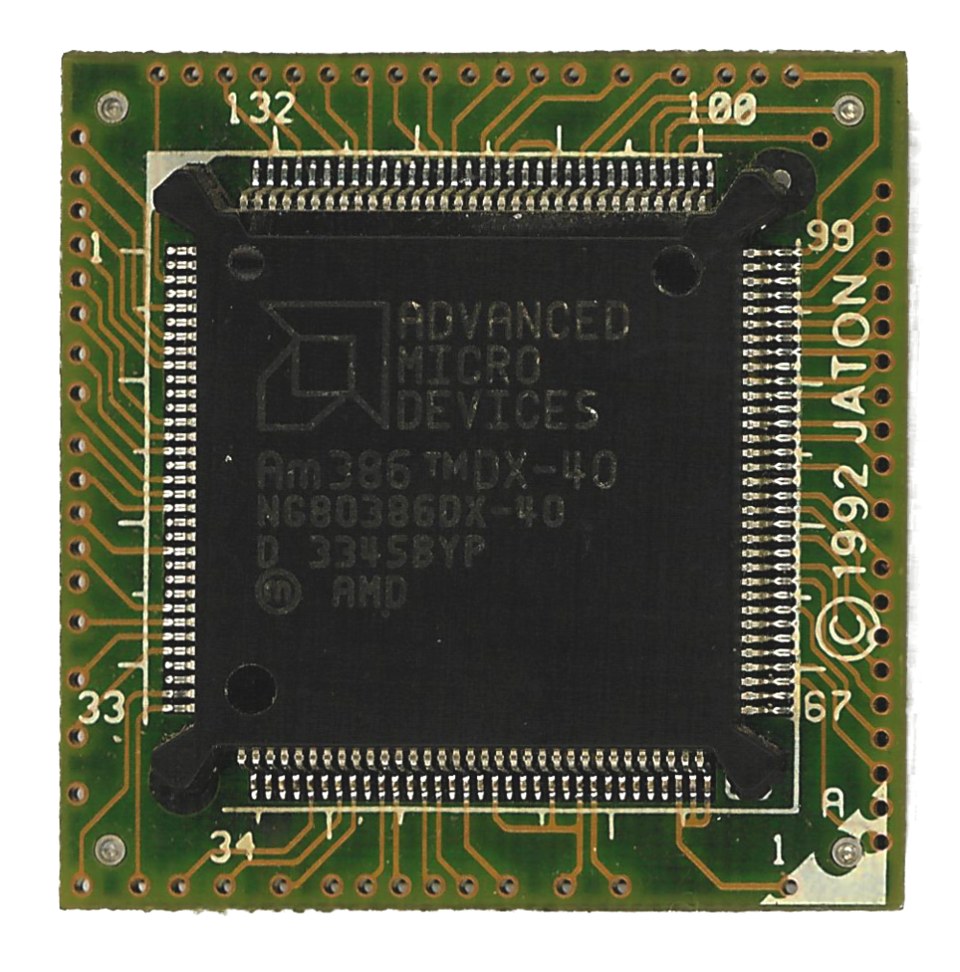
An AMD Am386DX-40, the 40 MHz 386. Photo: ZyMOS, CC BY-SA 4.0, via Wikimedia Commons.
PC, 386 DX40
This PC was built around a 40 MHz 386 processor of the kind AMD sold as the Am386DX-40, a clone of Intel's 80386 that AMD released in March 1991 after a long legal dispute with Intel. Intel's own 386 stopped at 33 MHz, and the 40 MHz Am386 was popular with clone makers and budget buyers because it came close to 486 performance at a much lower price.
Recalled by Alexander · listed as “PC, 386 DX40, 512 KB RAM, 40 MB hard disk”
The first computer.
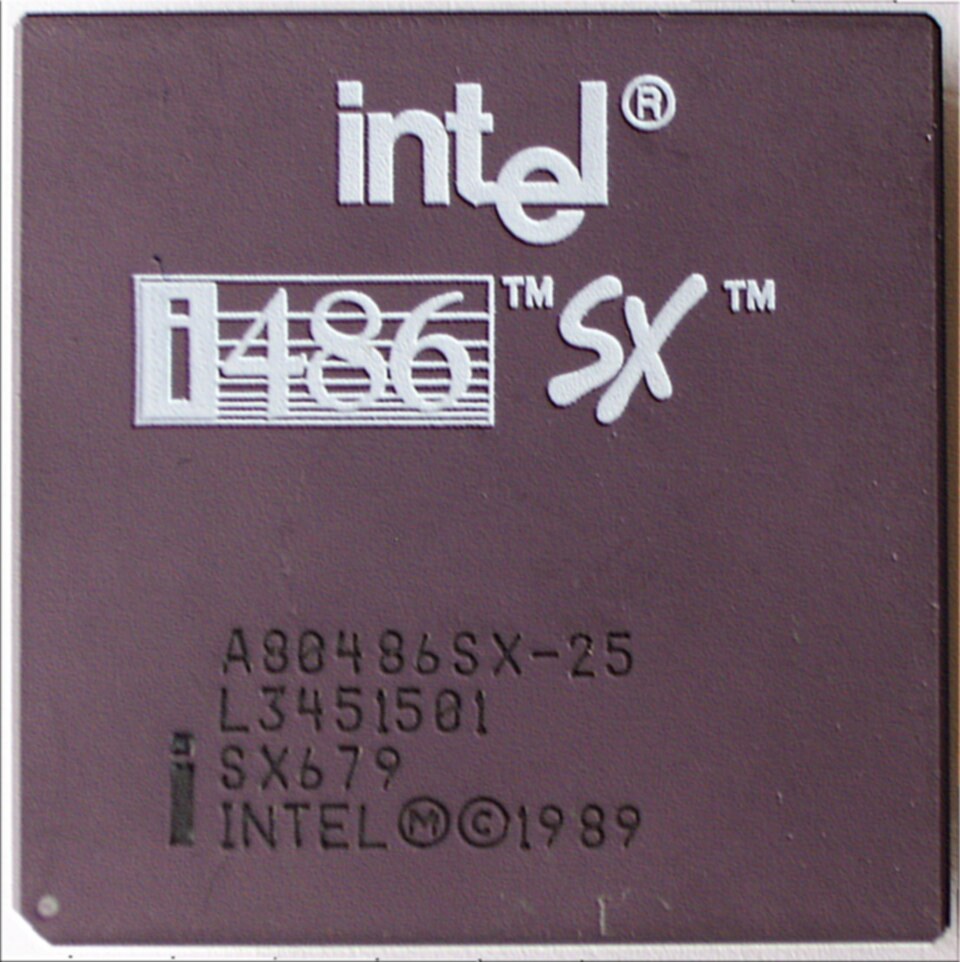
An Intel 486SX-25 processor. Photo: Benpicco, Public domain, via Wikimedia Commons.
PC, 486 SX25
This PC used Intel's 486SX at 25 MHz. Intel introduced the 486SX in 1991 as a cheaper version of the 486DX with the floating-point unit disabled (and in later chips removed), while keeping a full 32-bit design, unlike the earlier 386SX.
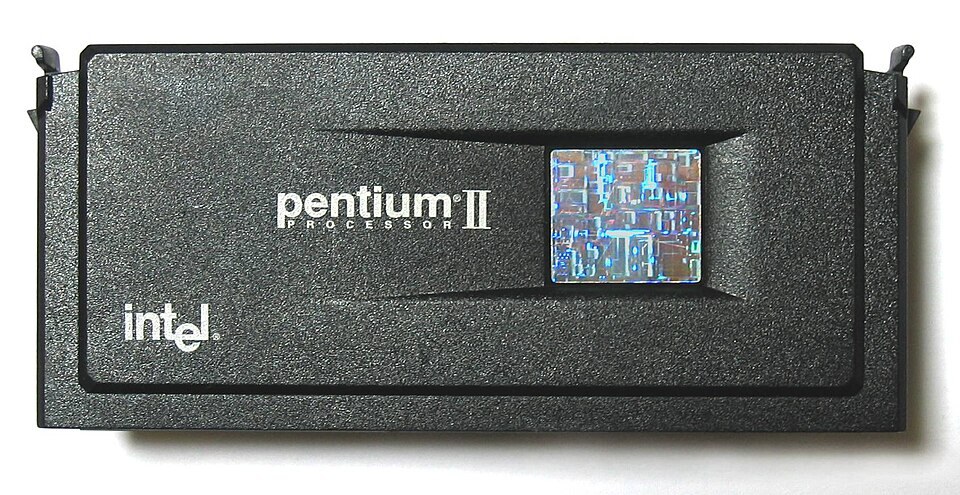
An Intel Pentium II processor. Photo: Qurren, CC BY-SA 3.0, via Wikimedia Commons.
PC, Pentium II 400
This PC ran a 400 MHz Intel Pentium II. The Pentium II, launched in May 1997, combined the P6 design of the Pentium Pro with MMX instructions and came on a Slot 1 cartridge, with its level-2 cache on separate chips running at half the processor speed. The 400 MHz model belongs to the 0.25 µm 'Deschutes' generation of 1998, which used a 100 MHz front-side bus.
1999 · The TC Studio · listed as “Pentium II 400, 512 MB RAM”
Main sequencing computer.
An Intel Pentium II processor. Photo: Qurren, CC BY-SA 3.0, via Wikimedia Commons.
PC, Pentium II 300
This PC ran a 300 MHz Intel Pentium II. The Pentium II, launched in May 1997, combined the P6 design of the Pentium Pro with MMX instructions and came on a Slot 1 cartridge, with its level-2 cache running at half the processor speed. The 300 MHz version first appeared on the original 0.35 µm 'Klamath' core in 1997 and was later also made on the 0.25 µm 'Deschutes' core.
1999 · The TC Studio · listed as “Pentium II 300, 192 MB RAM”
"WebMastering & MP3-handling"
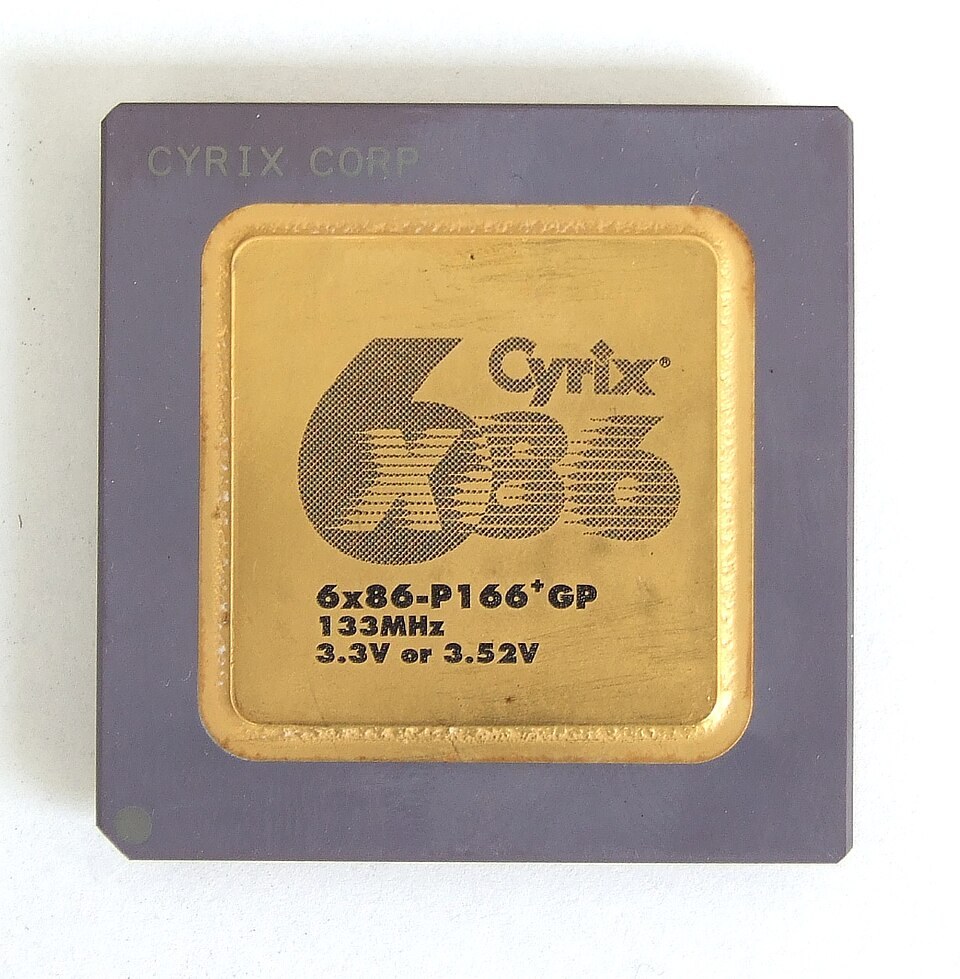
A Cyrix 6x86 P166+ processor. Photo: Appaloosa, CC BY-SA 3.0, via Wikimedia Commons.
PC, Cyrix 166+
This PC used a Cyrix 6x86 PR166+, a Socket 7 alternative to Intel's Pentium that Cyrix designed and IBM and SGS-Thomson manufactured. Its 'PR' rating compared it with Pentium clock speeds: the PR166+ actually ran at 133 MHz on a 66 MHz bus. The 6x86 was strong at integer work but had a weaker floating-point unit, which hurt it in games such as Quake.
1999 · The TC Studio · listed as “Cyrix 166+, 64 MB RAM”
Control station for the Yamaha A3000.
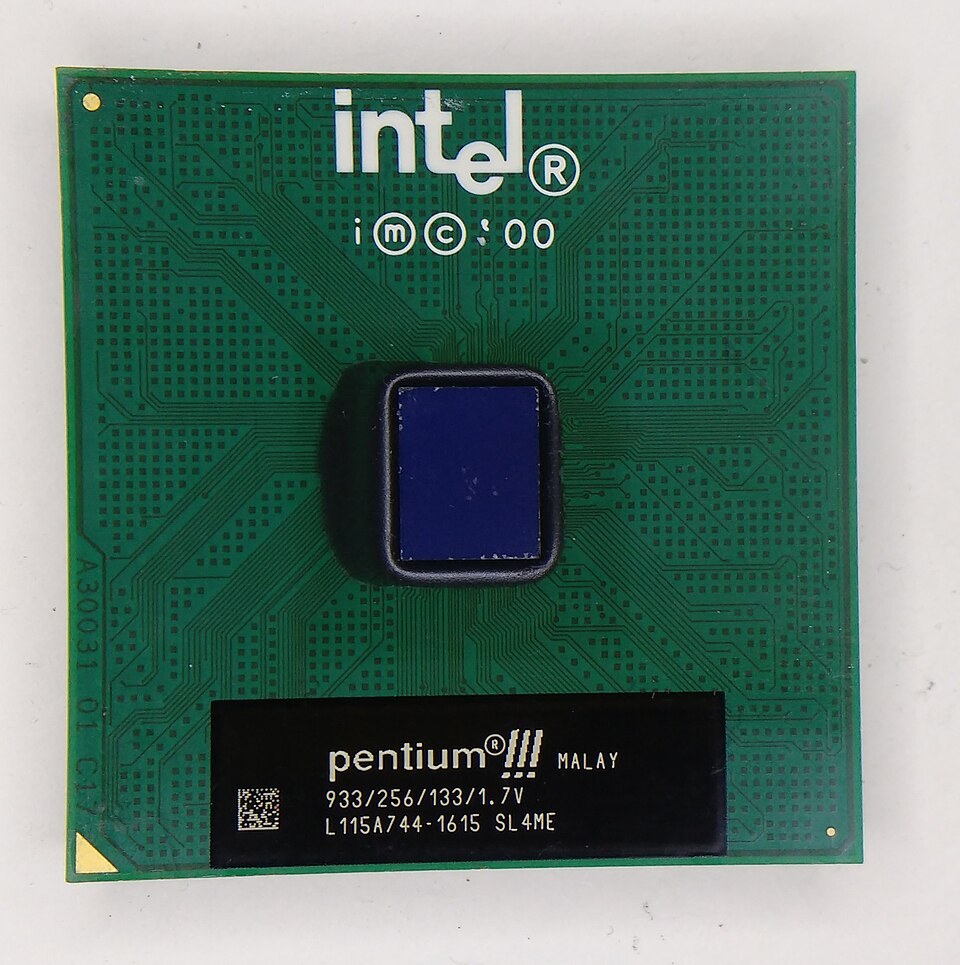
An Intel Pentium III 933 processor. Photo: ZyMOS, CC BY-SA 4.0, via Wikimedia Commons.
PC, Pentium III 933
This PC ran a 933 MHz Intel Pentium III. The Pentium III, introduced in February 1999, added the SSE instruction set to Intel's P6 design; the 933 MHz model uses the 0.18 µm 'Coppermine' core, which put 256 KB of full-speed level-2 cache on the processor die and was sold in both Slot 1 and Socket 370 versions.
2001–2002 · The Storage Room · listed as “PC, Pentium III 933 MHz”
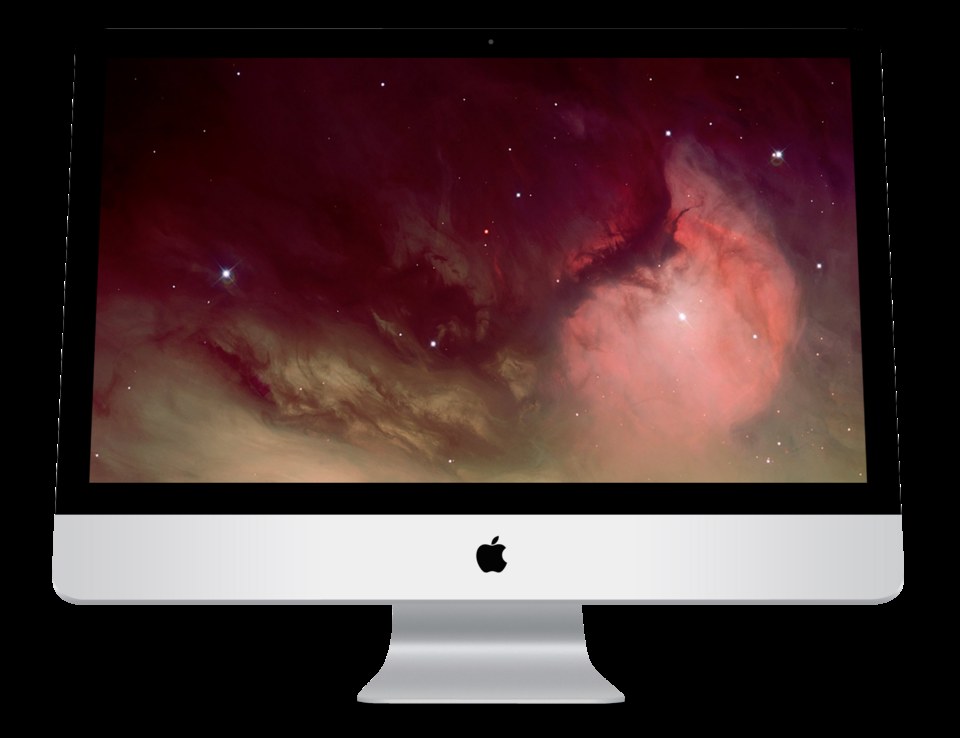
A 27-inch aluminium iMac of the same design. Photo: Matthieu Riegler, CC BY 3.0, via Wikimedia Commons.
Apple iMac 27″
Apple · 2011
Apple's 27-inch iMac of mid-2011, introduced on 3 May 2011, is an all-in-one computer with a 2560 × 1440 LED-backlit IPS display, quad-core Intel 'Sandy Bridge' processors and two Thunderbolt ports. The 3.4 GHz quad-core Core i7 (i7-2600) was a build-to-order option from Apple's online store, as was a solid-state drive. Apple officially supported up to 16 GB of RAM, though the machine accepts 32 GB, and macOS High Sierra was the last version it officially runs.
2012 · The new studio · listed as “Apple iMac 27″ (3.4 GHz Intel Core i7, SSD, 12 GB RAM)”
2015–2017 · Studio 7 · listed as “Apple iMac 27″ (3.4 GHz Intel Core i7, SSD, 32 GB RAM)”
Sony 24″ CRT monitor
Sony
A 24-inch widescreen CRT computer monitor from Sony; the exact model is not recorded. Sony's 24-inch widescreen Trinitron monitors included the GDM-W900 of 1997, with a curved aperture-grille tube and a maximum of 1920 × 1200 pixels, and its successor the GDM-FW900 of 2001, which used Sony's FD Trinitron tube. Both have a 16:10 picture, though the W900 could also be driven in 16:9 modes such as 1920 × 1080.
A MIDI and audio sequencer that began as Notator Logic, released by the German company Emagic in 1993 for the Macintosh and later also for Atari ST and Windows. In the late 1990s it was sold as Logic Audio in several editions, with Gold the middle tier between Silver and Platinum. Apple bought Emagic in July 2002 and ended the Windows version (the last was 5.5.1); the program continued on the Mac as Logic Pro, with Logic Pro 9 in 2009, Logic Pro X in July 2013 and Logic Pro 11 in 2024.
1999 · The TC Studio · listed as “Logic Audio Gold”
2001–2002 · The Storage Room · listed as “Emagic Logic Audio Gold”
2012 · The new studio · listed as “Apple Logic Pro”
2015–2017 · Studio 7 · listed as “Apple Logic Pro 9”
2015–2017 · Studio 7 · listed as “Apple Logic Pro X”
Steinberg WaveLab
Steinberg · 1995
An audio editor from Steinberg, started in 1995 and written largely by one programmer, Philippe Goutier; it ran on Windows at first and later also on macOS. Version 2.0 (1998) added transfer of samples to hardware samplers, analysis tools for peaks, loudness and clipping, and support for VST plug-ins, and version 3 (2000) introduced the Audio Montage for non-destructive multitrack editing. WaveLab is widely used for mastering and can produce DDP master files.
1999 · The TC Studio · listed as “Steinberg WaveLab 2.0”
Propellerhead ReCycle
Propellerhead · 1994
A loop editor from Propellerhead, released in 1994 and developed with Steinberg. It finds the individual hits in a drum loop and cuts the loop into slices, so it can follow a new tempo without changing pitch, and saves the result in Propellerhead's REX format (later REX2, with stereo), which many sequencers and samplers support. Wikipedia credits it with popularising loop slicing; Reason Studios, as Propellerhead is now called, re-released it as a free download in 2025.
Software from the Swedish company Propellerhead that emulates two Roland TB-303 bass synthesizers and a TR-808 drum machine, each with its own pattern sequencer, plus distortion and delay. It was released with Steinberg in 1997 for Mac and Windows and was noted for its low processor load. Version 2.0 (1998) added a TR-909 and official support for user-made 'mods' that changed its look and sounds; development ended in 1999, and in 2005 the final version became a free download.
1999 · The TC Studio · listed as “Propellerhead ReBirth RB-338 2.0”
Stomper
A Windows program for synthesising drum sounds, written in the 1990s by Håkan 'Zap' Andersson (known as Master Zap) and given away as 'MusicWare': users were asked to send the author some of their music instead of paying. It builds sounds by mixing sine-wave and narrow-band noise oscillators whose pitch, level and tone change over time, in the manner of analogue drum machines such as the TR-808 and TR-909. Later versions (Ultra, Ultra+, Ultra++) added more waveforms, resonant filters, WAV files as oscillators and cross-modulation between oscillators.
A software synthesizer from u-he, released in 2011; the name stands for 'Dinosaur Impersonating Virtual Analogue'. It models oscillators, filters and envelopes from classic analogue synthesizers, among them the Minimoog, Jupiter-6, Jupiter-8, Alpha Juno and MS-20, and the user chooses among five oscillator and five filter models. u-he describes it as the first native software synth to run methods from industrial circuit simulators in real time, with zero-delay-feedback filters, which gives an analogue-like sound at a high processor cost; it plays up to 16 voices.
A sample-based ('rompler') software instrument from reFX, released in August 2008 as the second version of Nexus. It plays layered preset sounds through filters, an arpeggiator, effects and a modulation matrix, and its library is extended with genre-based expansion packs. Nexus 2 brought more than 70 new features, among them an analogue-style phaser and per-oscillator level and pan.
A polyphonic software synthesizer from Reveal Sound, its first product, released in September 2013. It has four oscillators with modes such as Classic, FM, AM sync, saw PWM and Vowel, each with up to nine unison voices for 'supersaw'-style sounds, plus two multimode filters, four envelopes, four LFOs, two step sequencers, an arpeggiator and built-in effects. Wikipedia notes that it has been used almost exclusively in dance music.
A drum and one-shot sampler plug-in from Vengeance-Sound, released in 2013. It has 16 channels or pads, each holding two sample layers, with 12 filter types, envelopes and LFOs, per-channel effects including reverb, delay, distortion, EQ and compression, time-stretching, pitch-shifting and a scratch function, and each channel can go to its own output. It came with a factory library of 3,000 or 6,000 samples depending on edition.
A software emulation of Roland's SH-101 monophonic synthesizer by Patrick Kunz's TAL (Togu Audio Line), released in 2013. Like the original it has one oscillator mixing saw, pulse and noise with a sub-oscillator, a self-oscillating 24 dB low-pass filter and a single envelope; the filter uses zero-delay-feedback modelling, and all waveforms are generated in real time rather than sampled. It adds an arpeggiator and step sequencer of up to 96 steps and an optional six-voice polyphonic mode.
A software emulation of Roland's TB-303 bass synthesizer from AudioRealism, with a 303-style pattern sequencer for setting accent, slide and octave per step; the sound is synthesised, not sampled. The line went through ABL2 and then ABL3, a complete redesign released in 2015 as a Reason Rack Extension and in 2016 as VST and AU plug-ins, which added a pattern randomiser and a wave analyser that can transcribe 303 lines from audio.
A USB webcam that Logitech introduced in 2000 as a high-end model in its QuickCam line, a range Logitech had taken over from Connectix in 1998. It has a 640 × 480 colour CCD sensor (Sony ICX098AK), a manual focus ring and a built-in microphone. A 2001 review found that it captured about 15 frames per second at full resolution and 30 at 320 × 240, with good colour in bright light but muddy pictures in dim light.
2001–2002 · The Storage Room · listed as “Logitech QuickCam Pro 3000 (Studio CAM)”
Live video and camera-microphone audio from the studio, distributed through DI.FM. Codec and protocol not yet confirmed.
On the wish list
Wanted for Studio 7, never in the studio.
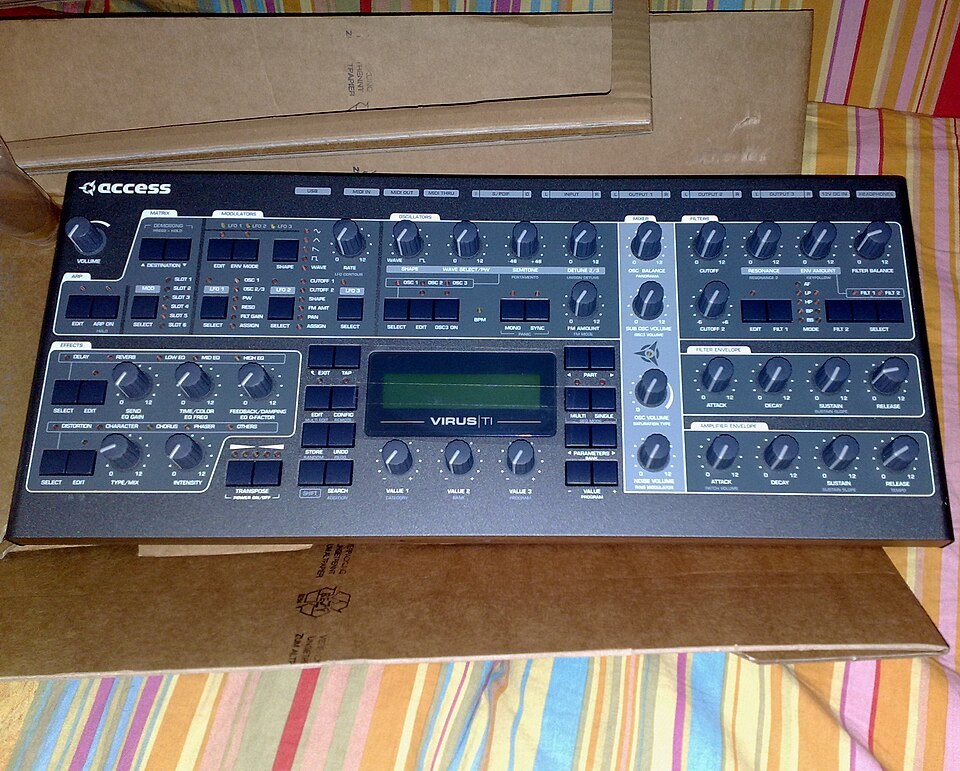
An Access Virus TI2 Desktop. Photo: R31bi, CC BY-SA 3.0, via Wikimedia Commons.
Access Virus TI2 Desktop
Access · 2009
The tabletop model of the Virus TI2, the 2009 revision of the Virus TI range from the German company Access Music; an optional kit lets it be rack-mounted. Its dual-DSP engine combines virtual-analogue, wavetable, HyperSaw (up to nine stacked oscillators), grain and formant oscillators with multimode filters and a filter modelled on the Minimoog's cascade design, and is 16-part multitimbral; the TI2 added faster DSPs and more polyphony than the TI. Through Access's 'Total Integration' it connects to a computer over USB, streams its audio into the DAW and is edited and automated like a plug-in instrument. The Virus was used extensively in trance and techno, and Access confirmed in early 2024 that TI2 production had stopped.
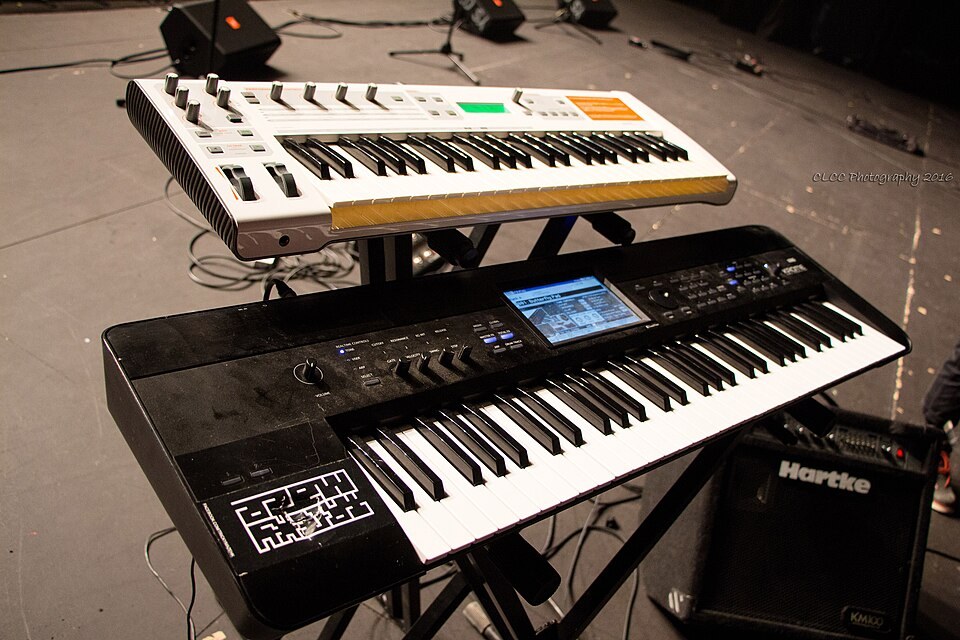
An M-Audio Venom, on top of a Korg Krome. Photo: chcleung, CC BY-SA 2.0, via Wikimedia Commons.
M-Audio Venom
M-Audio · 2011
A 49-key, 12-voice synthesizer that M-Audio (then part of Avid) launched at the NAMM show in January 2011 and sold as virtual analogue. Rather than modelled oscillators it uses waveforms sampled from vintage analogue synths, FM synths and drum machines, with three oscillators per voice, a multimode filter and a 16-slot modulation matrix; up to four sounds can be layered or split in Multi mode. It doubles as a USB audio and MIDI interface, and detailed sound editing is done in the bundled Vyzex software editor.
The M/S Master is an analogue mid/side processor for mastering from the German manufacturer SPL (Sound Performance Lab). It splits a stereo signal into its mid (centre) and side components so that each can be processed separately, with insert points for external equipment on both paths, and then converts it back to left and right. Front-panel controls set stereo width, left/right balance and the level of the centre signal, with a switchable low-shelf EQ on the side signal, and the meters can show either left/right or mid/side levels. SPL first showed it as a prototype in 2010; it is now discontinued.
The Stereo Vitalizer Mk2-T is a 1U stereo enhancer, which SPL calls a program equaliser, and is a valve version of the Vitalizer Mk2. SPL's patented Vitalizer process combines equalisation with psychoacoustic processing to make a mix sound fuller and more detailed across the whole frequency range, with controls for drive, bass character, bass compression, mid/high tuning, overall process level, an LC high-frequency filter and stereo width. Two 12AX7 dual-triode valves sit in the mid/high filter and the stereo expander. Sound On Sound reviewed it in 1999 and found it easy to set up and smooth-sounding; SPL has since replaced it with the Vitalizer Mk3-T.
The PCM96 is a 1U stereo reverb and effects processor from Lexicon, introduced in 2007. It offers 28 reverb, delay and modulation algorithms with more than 1,200 factory presets, 24-bit converters, 32-bit floating-point processing and sample rates up to 96 kHz, with analogue and AES/EBU digital inputs and outputs on XLR connectors. Two FireWire ports let it stream up to four channels of audio to and from a computer and be controlled as a plug-in inside a recording program, and it can also be controlled over Ethernet. Sound On Sound called it an impressive-sounding and very flexible reverb.
The MX400 is a 1U reverb and effects processor from Lexicon, shipped in 2006, with four inputs and four outputs. It contains two independent stereo processors that can also be combined into one surround processor, with Lexicon reverbs, delays and modulation effects plus dbx compression and de-essing, and 223 factory presets including 25 surround programs. Over USB its settings can be edited and automated from a recording program as a 'hardware plug-in', although the audio itself still runs through the analogue or S/PDIF connections. The MX400 has jack connectors and the otherwise identical MX400XL has XLRs.